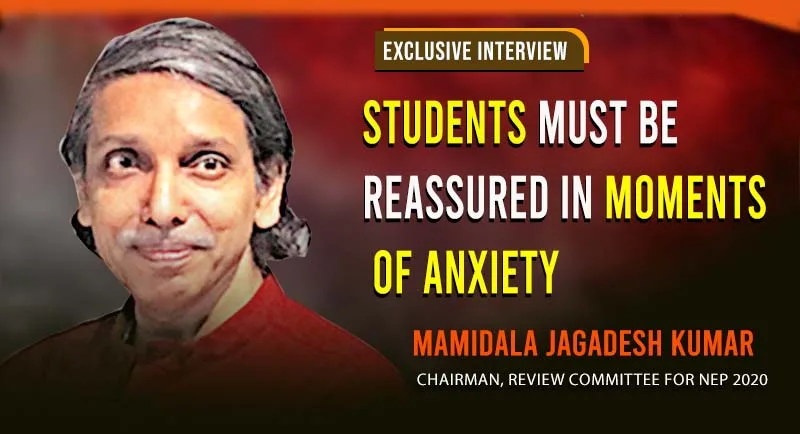
The NEET 2026 controversy has reignited debate over the credibility and scale of India’s entrance examination system. In this conversation with Prafulla Ketkar, Editor of Organiser Weekly, Mamidala Jagadesh Kumar, Chairman, Review Committee for NEP 2020, Ministry of Education and former Chairman, UGC, explained the structural challenges, proposed reforms, and the future direction of national testing mechanisms
Entrance examinations in India seem to generate a lot of emotion and public attention. Why is that so?
In India, students are highly aspirational and Entrance tests have become very important in their lives since these tests ensure that admissions in higher education institutions (HEIs) are objective and fair. Students spend years preparing for them, and families support these students emotionally and financially. When such tests are cancelled due to paper leak incidents, as witnessed in NEET 2026, it is natural if students experience anxiety and lose confidence. In such moments, the first priority must be to acknowledge the effort of students and support them with reassurance.
There has been a strong criticism of the National Testing Agency (NTA). How do you see this?
Criticism in such situations is understandable because expectations are high. However, it is equally important to take into account the magnitude of NTA’s responsibilities. It is not handling a single examination but a range of national-level tests with varied objectives, formats and participants. We must consider the broader range and complexity of its operations while assessing the performance of NTA.
Which examinations does NTA conduct?
NTA conducts nearly 17 tests in a year. These include large scale tests such as JEE Main for engineering, NEET for medical streams, CUET for university admissions, and UGC-NET for academic and research eligibility. These examinations cater to different disciplines and institutions. When all these are taken together, the annual number of test participants can exceed one crore. NTA conducts these tests in multiple languages and geographical regions, making NTA a unique organisation performing highly demanding operations.
“For a country of our size, we need an efficient and robust national testing institution such as NTA to conduct large-scale examinations. Without it, the process will become fragmented and inconsistent. The government is already taking several steps based on Dr Radhakrishnan committee’s recommendations to make NTA more resilient so that fairness and confidence are preserved“
Since NTA manages such a large testing ecosystem in the country, what are the key operational challenges in conducting such examinations?
The challenges are multi-dimensional. While the experts set question papers at NTA, the operations include secure question paper printing, their storage, transportation, distribution across 5400 centres, identity verification of candidates, and timely evaluation and result declaration. Maintaining integrity and efficiency at this scale is a complex national exercise involving logistics, technology and governance.
Doesn’t the recent NEET 2026 incident indicate that NTA has failed as an institution?
The paper leak in NEET 2026 was unfortunate. It is the pen-and-paper, single-day nature of NEET which might have led to such vulnerabilities. NTA has cancelled very few examinations due to paper leak incidents.
Do you think NEET in the present format has inherent risks?
Unlike the large scale tests conducted by NTA, NEET is a single session one day test using a pen-and-paper format. With more than 22 lakh candidates and over 5400 centers across India and abroad, NEET is a logistic and security challenge. The physical handling of question papers from printing to distribution leads to many points of vulnerability which criminal elements will try to breach as it happened in the case of NEET 2026. Whenever a national entrance test depends on one event, evidence of a paper leak could necessitate the cancellation of the entire examination.
What advantages does computer-based testing (CBT) offer if NTA conducts NEET in CBT mode?
The primary advantage of CBT is that it does not require physical processes such as printing and transporting question papers. CBT uses encrypted digital delivery of question papers, controlled access, and the ability to monitor processes closely through audit trails. For large exams, since NTA conducts the CBT in multiple sessions, any disruption gets confined to a specific shift or location. NTA can then isolate and address the disruption without cancelling the exam nationwide affecting the entire candidate pool.
What reforms have been suggested by Dr K Radhakrishnan’s committees?
The committee chaired by Dr K Radhakrishnan has suggested to conduct large exams with registrations of more than 2 lakhs in multiple sessions and using well-defined normalisation techniques to ensure fairness. It also suggested an alternate hybrid model. In this model, question papers are first digitally transmitted securely to the test centers. They are then printed in a controlled environment at centres to reduce physical handling logistical risks. The committee also suggested that NTA should move towards more advanced testing systems, including adaptive models.
Many students worry about normalisation. Is that concern justified?
One can understand the concerns about fairness, and such fears should be dispelled through clear communication. Normalisation is a scientifically proven statistical method. Normalisation ensures that differences in difficulty across exam sessions do not disadvantage or advantage any candidate because the process creates a level playing field. When properly explained and transparently implemented, normalisation can actually strengthen trust in the multi-session examination process.
What is the broader lesson from the current crisis?
The foremost lesson is that, for a country of our size, we need an efficient and robust national testing institution such as NTA to conduct large-scale examinations. Without it, the process will become fragmented and inconsistent. The government is already taking several steps based on Dr Radhakrishnan committee’s recommendations to make NTA more resilient so that fairness and confidence are preserved.