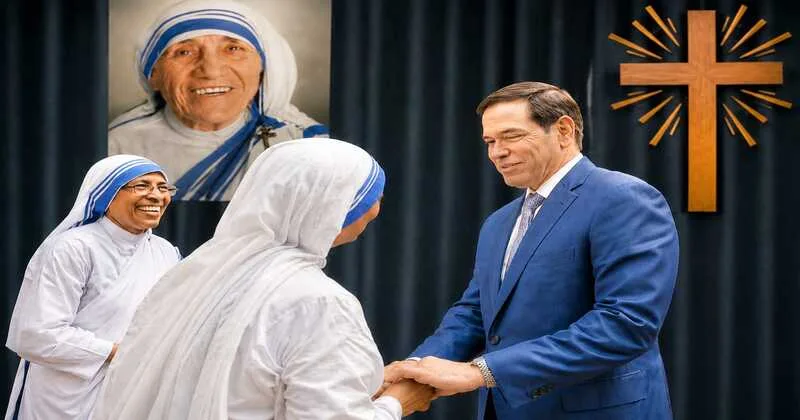
When US Secretary of State Marco Rubio landed in Kolkata on May 23, 2026, the symbolism of his first India visit was impossible to miss. The new US Secretary of State did not begin with trade negotiations, strategic technology, or Indo-Pacific security. Instead, he headed straight to Missionaries of Charity, the organisation built by Mother Teresa. Accompanied by his wife Jeanette D Rubio and US Ambassador Sergio Gor, Rubio spent nearly two hours at the Mother House in Taltala, paid homage at Teresa’s tomb, met nuns, and visited one of the organisation’s homes. The optics were carefully curated. Rubio became the first US Secretary of State to visit Kolkata since Hillary Clinton visited the city in 2012. But Rubio’s Kolkata stop was not merely religious tourism. It came at a politically charged moment, amid renewed Evangelical pressure regarding India’s proposed amendments to the Foreign Contribution Regulation Act (FCRA), repeated American “religious freedom” campaigns targeting India, and growing scrutiny of foreign-funded missionary ecosystems operating inside the country.
Just days before Rubio’s arrival, U.S. Congressman Chris Smith published an article in the Washington Examiner urging the State Department to intervene against proposed FCRA amendments in India. Smith specifically invoked the Missionaries of Charity as an example, warning that under the proposed changes, properties, schools and hospitals belonging to foreign-funded organisations could face seizure if licences lapse. The messaging was unmistakable that America was signalling that India’s tightening oversight of foreign-funded religious organisations would become an international political issue. What emerged from Rubio’s Kolkata choreography was not simply a tribute to Mother Teresa. It exposed a much larger geopolitical story, one involving missionary networks, soft power influence, American domestic electoral politics, and growing Indian resistance to foreign-funded religious intervention.
Mother Teresa left a tremendous legacy of compassion and service. I was honored to visit the Missionaries of Charity today to pay homage to her legacy and to see the living example of the Catholic faith in action. pic.twitter.com/HCiATKgUDc
— Secretary Marco Rubio (@SecRubio) May 23, 2026
Missionary networks as instruments of western influence
The British Empire understood the strategic utility of missionary networks long before modern diplomacy institutionalised “human rights” language. Missionary activity frequently moved alongside imperial expansion, cultural penetration and political influence. In the twenty-first century, the methods have changed, but the underlying architecture remains remarkably similar. Today the vocabulary is softer, “religious freedom,” “civil society,” “humanitarian protection,” “minority rights.” Yet the pressure ecosystem often operates through the same transnational networks of churches, advocacy groups, NGOs and Western political institutions. Rubio’s visit highlighted precisely this convergence.
The Missionaries of Charity has long occupied a unique position in the Western imagination. Wrapped in the imagery of white saris, dying destitute patients and saintly sacrifice, the organisation became one of the most successful soft-power brands ever exported from India to the West. That symbolism proved enormously useful not only for the Vatican and global Catholic institutions, but also for Western political actors seeking moral leverage over India. For years, American bodies like the United States Commission on International Religious Freedom have repeatedly pushed to designate India as a “Country of Particular Concern.” The framing almost always revolves around anti-conversion laws, NGO regulation, minority issues, or restrictions on foreign-funded Christian organisations.
#WATCH | Kolkata, West Bengal: On US Secretary of State Marco Rubio’s visit, Sister Concettina, the Secretary General of the Missionaries of Charity, says, “It was his initiative to come to the Mother House, and it was a joy for us to welcome him because he wanted to receive… pic.twitter.com/CXhvj66Acw
— ANI (@ANI) May 23, 2026
Rubio’s Kolkata appearance therefore functioned as diplomatic signalling on multiple fronts simultaneously, toward India’s government, toward Christian evangelical and Catholic constituencies in the United States, toward global missionary networks, and toward the wider Western rights ecosystem that increasingly treats India’s sovereignty-based regulation of NGOs as “religious suppression.” The timing mattered enormously because the Missionaries of Charity itself had previously faced FCRA scrutiny in 2021–22 before its licence was restored in July 2022.
The FCRA battle and India’s sovereignty push
India’s Foreign Contribution Regulation Act has become one of the central battlegrounds in the larger conflict between national sovereignty and transnational influence networks. The Modi government’s position has been consistent that foreign funding entering India through NGOs, charities, advocacy groups or religious institutions cannot remain outside sovereign oversight. New Delhi increasingly views unrestricted foreign funding not as benign philanthropy, but as a potential channel for ideological intervention, political mobilisation, demographic engineering and influence operations. This perspective did not emerge in a vacuum.
For years, multiple foreign-funded organisations across sectors, environmental activism, conversion-linked charities, political advocacy groups and identity-based mobilisation platforms, have been using humanitarian or developmental language while simultaneously pursuing ideological agendas.
The Missionaries of Charity controversy became a flashpoint within this larger debate. In 2021, renewal of the organisation’s FCRA licence was halted following adverse inputs. Though the licence was later restored in July 2022, the episode triggered intense international mobilisation. American lawmakers, church groups and global rights networks rapidly framed the matter not as a regulatory issue, but as evidence of “religious persecution.” Chris Smith’s recent intervention revived exactly that framework. His warning that Missionaries of Charity assets could be seized under proposed amendments was designed to internationalise India’s domestic regulatory process.
From India’s standpoint, however, the issue is fundamentally about accountability. If organisations receive massive foreign funding while operating schools, orphanages, shelters or religious programmes inside India, the state argues it has every right to monitor finances, activities and compliance. The disagreement is therefore not merely legal; it is civilisational and strategic. Washington frames the issue through “religious freedom.” Delhi increasingly frames it through “national sovereignty.”
The Mother Teresa myth and the politics of sainthood
Rubio’s visit also reopened debate over the carefully constructed global mythology surrounding Mother Teresa herself. Born as Anjeze Gonxhe Bojaxhiu in Skopje in 1910, Teresa arrived in India as a Catholic nun and founded the Missionaries of Charity in Kolkata in 1950. Over time she became one of the most celebrated religious figures in the world, culminating in canonisation by the Vatican in 2016. Yet behind the carefully maintained image of universal compassion lies a deeply controversial record.
Writer Christopher Hitchens spent years investigating Teresa and published The Missionary Position while also fronting the documentary Hell’s Angel. Hitchens reached a devastating conclusion that Mother Teresa was “not a friend of the poor” but “a friend of poverty.” His investigation documented repeated allegations surrounding, poor medical practices, reused syringes, inadequate hygiene, denial of pain management, secret baptisms of dying patients, and the glorification of suffering as spiritually desirable. Poverty and suffering were not treated as conditions to be eliminated, but as spiritual theatre reinforcing Catholic theology. Even as millions of dollars flowed into the organisation from Western donors, reports continued describing austere facilities lacking modern medical standards. Hitchens repeatedly asked a simple question that if the money existed, why were the conditions not transformed?.
The controversy extended far beyond healthcare. Teresa accepted donations and honours from deeply compromised political and financial figures, including American fraudster Charles Keating and Haiti’s Duvalier dictatorship. When Keating faced prosecution for financial crimes involving elderly victims, Teresa reportedly wrote to the judge requesting clemency on his behalf. Her critics argued that the organisation cultivated powerful patrons regardless of ethical considerations so long as funding and institutional expansion continued.
Meanwhile, covert conversion practices followed the Missionaries of Charity for decades. Former members described quiet baptisms of dying patients, often without meaningful informed consent.
From charity to conversion politics
The Indian state’s concern regarding foreign-funded missionary activity is not abstract. Several controversies involving Missionaries of Charity institutions intensified scrutiny in recent years. In 2018, a nun linked to a Missionaries of Charity home in Ranchi, Jharkhand, was arrested in connection with baby-selling involving infants from a shelter home. Authorities alleged illegal adoptions and trafficking practices involving vulnerable children. In Gujarat in 2021, police registered a case involving allegations that girls in a Missionaries of Charity institution were being pressured into Christian religious practices. Though legal proceedings later weakened for lack of conclusive evidence, the case reinforced existing concerns regarding conversion-linked activity within welfare institutions. Such episodes deepened a broader perception that some missionary ecosystems operate simultaneously as, humanitarian institutions, foreign-funded influence networks, and religious expansion mechanisms.
🚨 Kolkata: Two Missionaries of Charity sisters reportedly met Former West Bengal CM Mamata Banerjee on Friday, reports Republic.
A day later, US Secretary of State Marco Rubio visited the Missionaries of Charity 👀pic.twitter.com/4oPpN2XNFw
— Megh Updates 🚨™ (@MeghUpdates) May 23, 2026
For Washington and transnational church organisations, anti-conversion laws and FCRA regulations are framed as “majoritarian intolerance.” For India, however, these regulations are increasingly viewed as defensive mechanisms protecting cultural continuity and political sovereignty from externally financed ideological penetration. That difference in perception explains why Rubio’s Kolkata visit resonated so strongly.
To many in India, the visit appeared less like a tribute to humanitarian work and more like symbolic American backing for missionary ecosystems currently under increased sovereign scrutiny.
Rubio’s domestic audience and America’s electoral calculations
Rubio’s Kolkata stop also carried clear domestic political utility inside the United States. American politics increasingly operates through coalition signalling. Evangelical Christians, conservative Catholics and religious freedom advocacy groups remain influential constituencies within Republican politics. Public association with globally recognised Christian symbols strengthens credibility with those blocs.
The Missionaries of Charity offered Rubio an almost perfect stage that globally recognisable religious imagery, association with Catholic humanitarian symbolism, alignment with “religious freedom” narratives, and indirect pressure on a rising nationalist India. The convergence is particularly striking because Rubio’s visit occurred amid repeated American discourse portraying India as a democracy allegedly drifting toward “majoritarianism.”
This is where humanitarian symbolism becomes geopolitical leverage. By publicly foregrounding Mother Teresa and the Missionaries of Charity while debates over FCRA amendments intensify, Washington effectively inserted itself into India’s internal sovereignty debate without formal confrontation. The message was subtle but visible that America is watching how India regulates foreign-funded Christian institutions. That is why Rubio’s Kolkata visit cannot be understood merely as diplomacy. It was narrative construction.
India’s pushback against external moral pressure
India under Narendra Modi has steadily resisted Western attempts to frame domestic governance questions through externally defined moral categories. Whether the issue involves, NGO regulation, conversion laws, digital sovereignty, environmental activism, or religious institutions, Delhi’s posture increasingly reflects strategic suspicion toward transnational influence ecosystems. India has historically paid a heavy price for underestimating externally backed ideological intervention, first through colonial missionary structures, later through Cold War influence networks, and now through globally financed NGO ecosystems. From this perspective, FCRA enforcement is not “anti-charity.” It is a sovereignty instrument. Rubio’s visit therefore landed in an India far less willing to accept moral lectures from Western capitals than in previous decades. The irony is profound. The United States itself aggressively regulates foreign political influence, monitors overseas funding channels and scrutinises ideological interference. Yet when India attempts similar oversight regarding foreign-funded missionary organisations, the language suddenly shifts toward “religious freedom” and “civil society suppression.”
Rubio’s Kolkata pilgrimage ultimately revealed something much larger than personal faith or diplomatic courtesy. It exposed how missionary networks, humanitarian branding, religious freedom narratives and strategic signalling increasingly overlap in twenty-first century geopolitics. The British once carried empire through missionaries and commerce. Modern America increasingly carries influence through NGOs, rights language, soft power and transnational religious advocacy. India, however, is no longer the weak postcolonial state willing to absorb external pressure unquestioningly. The battle over FCRA, missionary funding and organisations like the Missionaries of Charity is no longer just about charity. It is about sovereignty, narrative control and who ultimately shapes India’s civilisational future.