
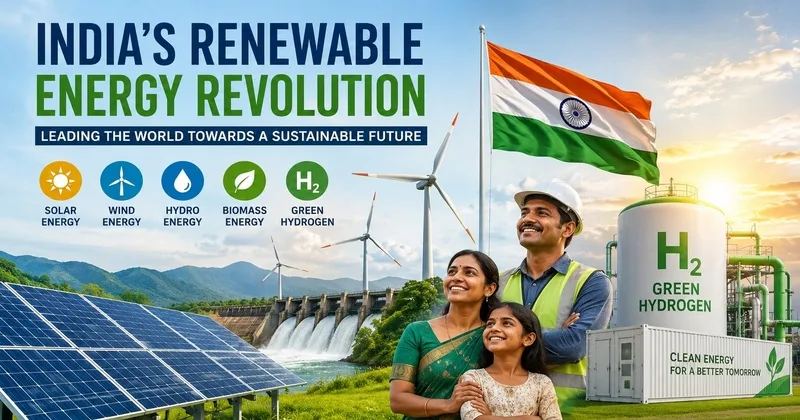
India’s transition toward renewable energy has become one of the most inspiring examples of sustainable development in the modern world. At a time when many countries are struggling to balance economic growth with environmental protection, India has shown that development and sustainability can move together. Over the last decade, the country has made remarkable progress in the field of renewable energy and has emerged as one of the global leaders in clean and green energy production. Through strong government policies, international partnerships, technological innovation, and public participation, India is steadily building a cleaner and more sustainable future.
India’s renewable energy journey is important because it comes from a country with a huge population and growing energy demands. Providing electricity to millions of people while reducing pollution and carbon emissions is a difficult challenge. However, India has successfully expanded its use of solar energy, wind energy, hydroelectric power, biomass, and green hydrogen. Large solar parks in states such as Rajasthan and Gujarat, wind farms in Tamil Nadu and Gujarat, and increasing use of rooftop solar panels have changed the country’s energy sector. Renewable energy is no longer seen only as an environmental necessity in India. It has become a major source of economic growth, employment, innovation, and energy security.
One of the biggest achievements of India is that it has already moved ahead of many global climate goals. India achieved the target of getting fifty per cent of its installed electricity capacity from non-fossil fuel sources years before the deadline set under the Paris Climate Agreement. According to recent reports, India’s non-fossil fuel energy capacity has crossed two hundred and sixty gigawatts. This makes India one of the largest producers of renewable energy in the world. The speed at which India has expanded its renewable energy sector shows the country’s commitment to sustainable growth and climate responsibility.
Solar energy has played a major role in India’s clean energy success. The government launched several important schemes, such as the National Solar Mission, to increase solar power production across the country. India is now home to some of the largest solar parks in the world. The cost of producing solar electricity has also reduced significantly, making renewable energy more affordable and accessible. The International Solar Alliance, launched by India and France, has further strengthened India’s position as a global leader in solar energy. This alliance encourages countries around the world to adopt solar technology and work together for a cleaner future.
India’s renewable energy sector has also created employment opportunities for thousands of people. Engineers, technicians, factory workers, and local communities are benefiting from the rapid expansion of renewable energy projects. Solar panel manufacturing, installation work, maintenance services, and clean technology industries are creating new jobs and supporting economic growth. Renewable energy is helping both urban and rural areas by providing better electricity access and improving infrastructure.
Another major reason behind India’s success is its growing international cooperation in the field of renewable energy. Recently, India and the Netherlands strengthened their partnership through important agreements related to clean energy and sustainability. Both countries agreed to work together on renewable energy technologies, green hydrogen development, energy storage systems, and sustainable industrial growth. A Joint Working Group was established under their renewable energy cooperation agreement to promote innovation and investment in the clean energy sector. India and the Netherlands are also working together on green hydrogen projects, which are considered an important solution for reducing carbon emissions in industries and transportation. These agreements show that developed countries trust India’s renewable energy capabilities and see India as an important partner in the global energy transition.
India’s renewable energy progress is closely connected with the United Nations Sustainable Development Goals, commonly known as SDGs. Renewable energy directly supports SDG Seven, which focuses on affordable and clean energy for all. Millions of households in India now have better access to electricity because of renewable energy expansion. India’s clean energy efforts also contribute to SDG Thirteen on climate action by reducing greenhouse gas emissions and encouraging sustainable development. Renewable energy projects support SDG Eight as well by creating jobs and promoting economic growth. Investments in clean infrastructure and innovation also support SDG Nine, which focuses on industry, innovation, and infrastructure development.
Renewable energy is also improving India’s energy security. For many years, India depended heavily on imported fossil fuels such as coal, oil, and gas. This made the country vulnerable to global price increases and international conflicts. By increasing domestic renewable energy production, India is reducing its dependence on imported fuels and becoming more self-reliant. The government’s focus on green hydrogen, battery storage, and electric vehicles will further strengthen India’s energy independence in the future.
Government policies and reforms have played an important role in this transformation. Schemes promoting solar manufacturing, incentives for renewable energy companies, and support for electric mobility have encouraged investment from both Indian and international companies. Many global businesses are now investing in India’s renewable energy market because of its strong growth potential and supportive policies. These partnerships are helping India become not just a participant but a leader in the global clean energy movement.
India’s renewable energy journey is an example of hope and determination for developing countries around the world. Despite economic and infrastructural challenges, India has shown that ambitious climate goals can be achieved with strong leadership, innovation, and cooperation. The country’s achievements in renewable energy reflect its vision of combining economic development with environmental protection.
Beyond statistics and policies, renewable energy is changing the lives of ordinary people in India. Solar-powered irrigation systems are helping farmers reduce costs and improve productivity. Villages in remote areas are receiving reliable electricity through renewable energy projects. Better electricity access is improving education, healthcare, communication, and small businesses. Women in rural areas especially benefit from cleaner energy sources and improved living conditions. These changes show that renewable energy is not only about technology but also about social development and inclusive growth.
India’s progress in renewable energy has improved its global image as a responsible and forward-looking nation. As the world continues to search for solutions to climate change and energy challenges, India stands out as a strong example of sustainable growth. With increasing innovation, expanding international partnerships, and continued investment in clean technology, India is well-positioned to remain a global leader in renewable energy for many years to come.