
Long before solar energy became a national priority, Gujarat had begun laying the foundation for India’s renewable energy growth. In the late 1970s, when India was still heavily dependent on conventional power and struggling with energy shortages, Gujarat began experimenting with renewable energy technologies through the Gujarat Energy Development Agency (GEDA). But the turning point came in 2009, when then CM Narendra Modi launched India’s first dedicated solar policy. At that time, solar energy was still expensive and limited, and India’s solar capacity was extremely small; most states focused on coal and thermal power to meet daily needs. But Gujarat saw solar as both an energy solution and an economic opportunity. The state offered guaranteed power purchase agreements, investor-friendly policies, land support, and fast approvals. This created confidence among private investors and helped Gujarat begin experimenting before the rest of the country.
What followed was not just a policy success story. It was a proof of concept that rewired the way India thought about energy. Gujarat’s model, built on guaranteed tariffs, private investment, and sheer political will, became the quiet blueprint for India’s audacious 100 GW solar ambition. One state’s bold bet didn’t just pay off. It changed the national trajectory. In this article, we will explore how Gujarat’s solar model inspired India.
Why Gujarat acted first
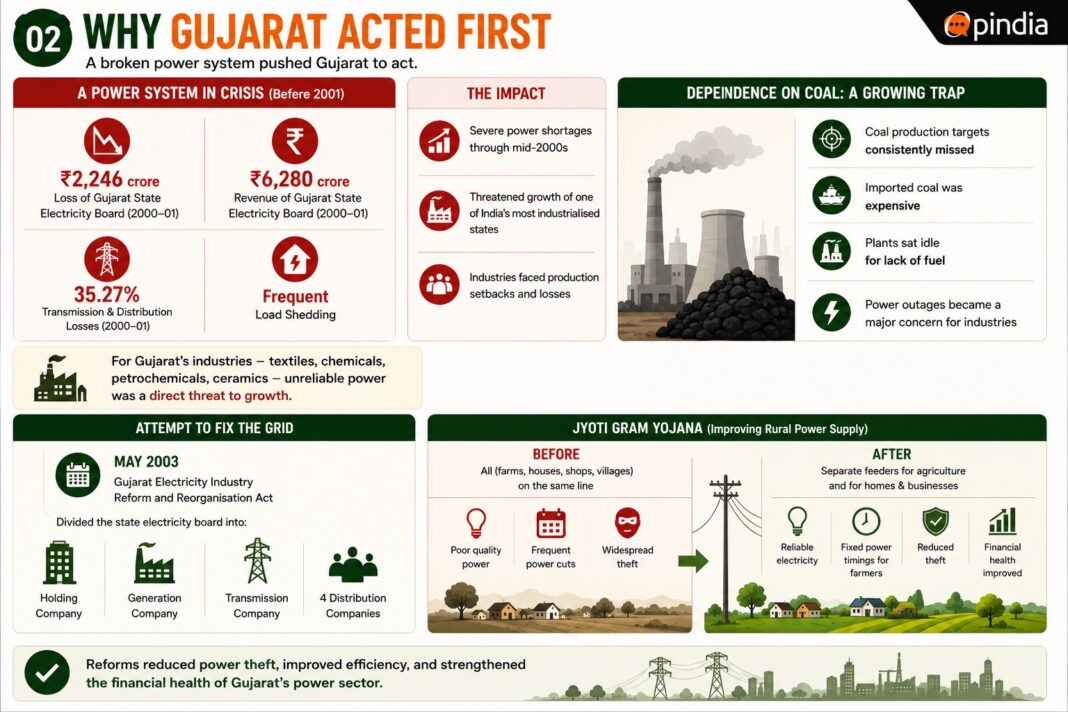
To understand why Gujarat moved first in solar, we need to understand how broken its energy system was just a few years ago. When Narendra Modi became the chief minister of Gujarat in October 2001, he found the state’s power situation grim. During 2000-01, the Gujarat State Electricity Board posted a loss of Rs. 2246 crore on revenue of just Rs. 6280 crore. Transmission and distribution losses stood at a staggering 35.27 per cent, and load shedding was frequent, indicating the state’s condition before Narendra Modi became the CM. Power shortages in Gujarat were particularly severe through the mid-2000s, driven by fast economic growth on the demand side and chronic coal shortages and plant outages on the supply side. For a state with one of India’s most industrialised economies, home to textiles, chemicals, petrochemicals and ceramics, but with unreliable power, wasn’t just an inconvenience. It was a direct threat to growth.
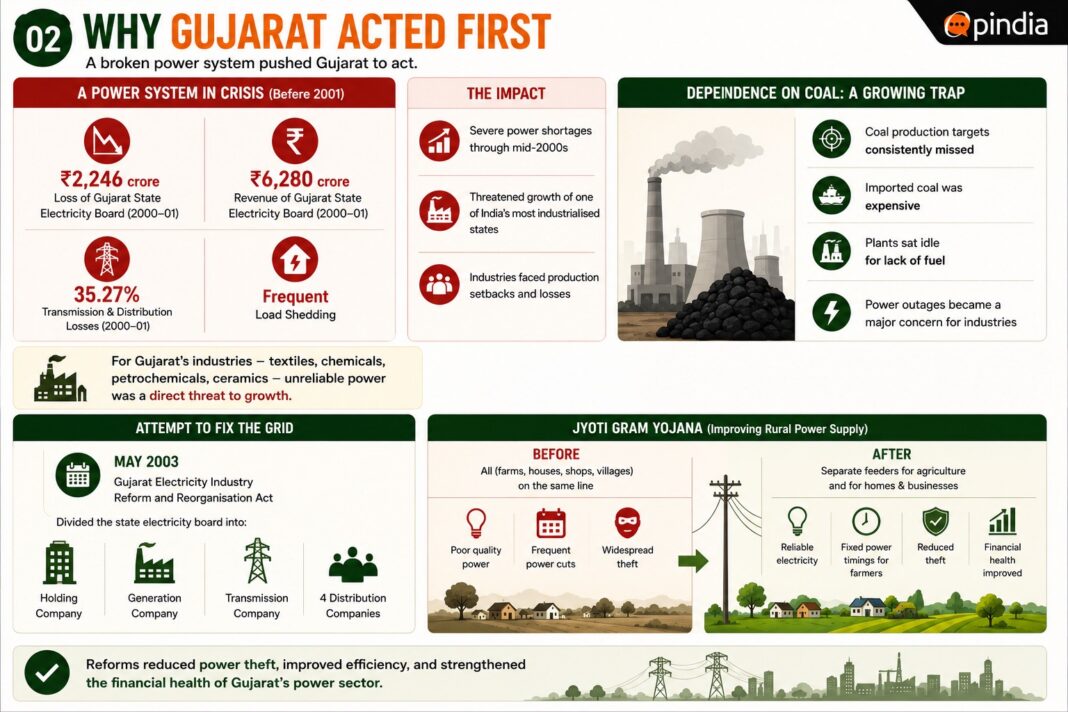
Like much of India, Gujarat was also dependent on cheap coal for decades to power its industries and fast-expanding cities. But the dependency was becoming a trap. Coal production targets were being missed year after year.
Imported coal was expensive, and plants were sitting idle for lack of fuel. Power outages due to a coal shortage had become a major concern for industries, which feared production setbacks. At first, Modi’s government attempted to fix the grid. In May 2003, the Gujarat government passed the Gujarat Electricity Industry Reform and Reorganisation Act, which divided the state electricity board into a holding company, a generation company, a transmission company, and four distribution companies. Along with this, the Gujarat government brought the Jyoti Gram Yojana scheme. It was launched to improve the electricity supply in villages. Before this scheme, all the farms, houses, shops, and villages received their supplies from the same line.
Under this scheme, the Gujarat government divided the electricity feeder lines into two parts, one for agricultural use and another for households, schools, shops, and villages. Earlier, villages suffered from poor-quality electricity, frequent power cuts, and widespread electricity theft because everything was connected to the same line. But after the scheme, Gujarat ensured that villages received more regular and reliable electricity, while farmers had power at fixed, predictable times. The reform also helped the government reduce power theft, track electricity usage more efficiently and improve the financial condition of the state’s power sector.
The 2009 solar policy that changed everything
After stabilising the electricity system, Gujarat began seeking a long-term solution to its growing needs. The state realised that it depended heavily on coal and conventional power sources, which were insufficient to meet its needs. As coal wasn’t reliable, either economically or sustainably, for the future. Gujarat also had a natural advantage in its vast stretches of barren land, high solar radiation, and more than 300 sunny days every year. Instead of viewing solar energy solely as an environmental initiative, the state saw it as an opportunity for economic growth, industrial expansion, and energy security.
In 2009, Gujarat became the first state to launch a full-fledged comprehensive solar power policy. At that time, solar was still considered risky and expensive. The policy aimed to attract private investment by offering guaranteed long-term power purchase agreements, fixed tariffs, land support and faster approvals. The government assured companies that if they invested in solar power generation, the state would purchase electricity at pre-decided rates, reducing uncertainty for investors.
This policy immediately changed Gujarat’s position in India’s energy sector. Private companies started investing in large-scale solar projects, and Gujarat quickly emerged as the country’s leading solar state. The policy also laid the foundation for several pioneering projects, including the Charanka Solar Park, rooftop solar schemes in Gandhinagar and the world-famous canal-top solar project over the Narmada canals. Many of these ideas later became templates for India’s larger National Solar Mission and renewable energy expansion.
Charanka Solar Park: India’s first mega solar experiment
The biggest symbol of Gujarat’s solar ambitions was the Charanka Solar Park. It was located in Charanka village, Patan district, near the India-Pakistan border. This project was launched in 2010 and inaugurated by then CM Narendra Modi. Charanka Solar Park became Asia’s largest solar park at that time. It was one of the world’s biggest projects. But why are we talking about it today? The answer lies in the details.
The project spanned thousands of acres, and the park followed a multi-developer model in which several private companies generated solar power from a single integrated location. Instead of having each company build its own roads, transmission lines, and infrastructure, the Gujarat government builds an entire ecosystem for solar developers by providing land, roads, transmission lines, and approvals. The entire ecosystem reduced the costs, attracted investment and accelerated project execution. Initially, the park generated around 214 MW of solar power, but its capacity later expanded to nearly 730 MW.
The project quickly became a national model for future mega solar parks across India, including projects in Rajasthan, Karnataka and Andhra Pradesh. For Gujarat, it wasn’t just a solar project, but it was proof that solar energy can be produced on an industrial scale in India. The project also helped Gujarat emerge as the country’s solar leader at a time when most Indian states were still hesitant about investing heavily in renewable energy. However, while the project received global attention for its scale and innovation, criticism also emerged from local communities. Villagers later claimed that grazing lands were lost, access to water became difficult, and many promises regarding jobs and development were not fully fulfilled. These concerns would later become an important part of the debate around large-scale renewable energy projects in India.
Rooftop solar: Turning homes into power producers
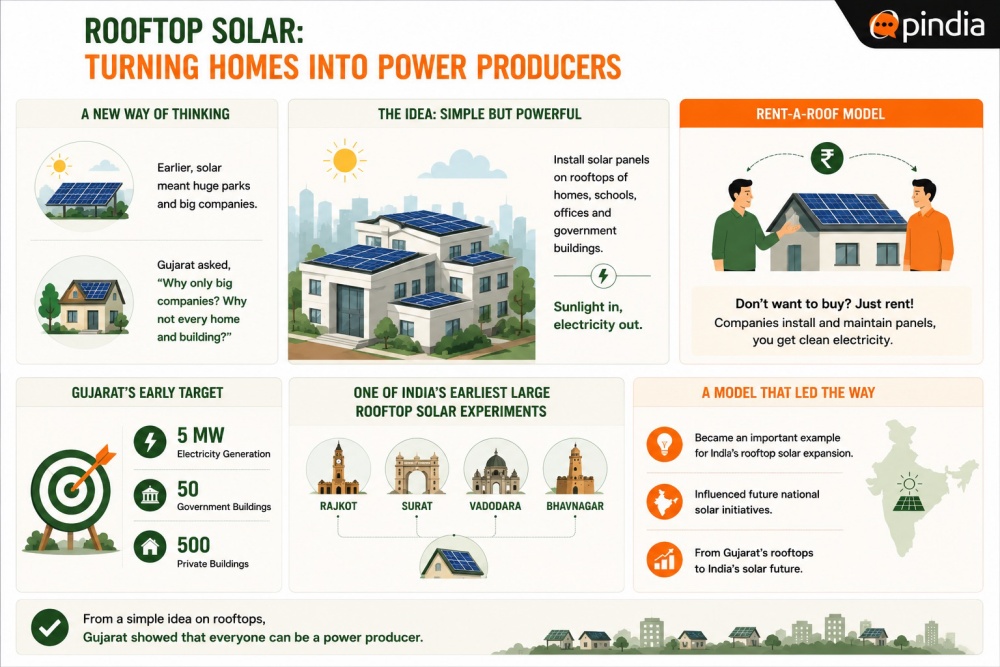
Earlier, Solar energy in India mostly meant huge solar parks in empty land and big companies generating electricity. But Gujarat thought, “Why only big companies? Why can’t normal buildings or houses produce electricity?” So, Gujarat launched the Rooftop Solar Scheme.
The idea was very simple: to install solar panels on the rooftops of houses, government buildings, schools, and offices. The sunlight would generate electricity directly from the rooftop. Gujarat introduced the “Rent-a-Roof “ model. Under this model, People do not even need to buy solar panels themselves; they can rent them from companies that have installed panels on rooftops, allowing them to engage directly in energy generation without bearing the full installation cost. The government initially planned to generate around 5 MW of electricity by installing solar panels on nearly 50 government buildings and 500 private buildings. It was one of India’s earliest large rooftop solar experiments in Gujarat, from which the government planned similar models in Rajkot, Surat, Vadodara and Bhavnagar. Later, rooftop solar became a major national policy across India. The scheme later became an important example for India’s broader rooftop solar expansion and influenced future national solar initiatives.
Canal-top solar: Gujarat’s global solar innovation
While Gujarat was rapidly expanding large solar parks, the government also began exploring ways to generate solar power without using vast amounts of land. Large solar parks require large land areas, which creates problems with land acquisition and is expensive. It led to the creation of a great innovation project – the Canal-Top Solar project. Instead of installing solar panels only on the open land, Gujarat decided to install them above the Narmada canal network.
It was launched by then CM Narendra Modi in April 2012. It was the first canal-top solar plant near Chandrasan in Kadi taluka, Mehsana district. Built over 750 metres (2,460ft) of the canal, the project generated 1 Megawatt (MW) of solar power. What made the project unique was that it solved multiple problems together. These panels generate clean solar energy while reducing evaporation from canals by shading the water. The government estimated that the project could save nearly 90 lakh litres of water annually. It actually helps reduce land costs. The canal-top model also reduced the need to acquire large stretches of land for solar parks, a task that was becoming increasingly difficult and expensive. Since Gujarat already had thousands of kilometres of canals, the state believed that even partial utilisation of this network could generate thousands of megawatts of solar power while conserving both land and water.
The project quickly gained national and international attention as an example of infrastructure innovation in renewable energy. Then, Union Renewable Energy Minister Farooq Abdullah praised Gujarat for pioneering the project, while other Indian states, such as Punjab and Delhi, later explored similar canal-top solar initiatives.
Modhera and the push towards solar villages
After becoming a leader in large solar parks and rooftop solar, Gujarat started promoting a new idea named “solar villages”. The aim was not just for cities or industries, but for entire villages to run on solar energy. The clearest example of this was the village of Modhera in Gujarat. It was famous for its historic Sun temple. But Gujarat wanted to make it India’s first fully solar-powered village. To achieve this, the government installed rooftop solar panels on houses, as well as a ground-mounted solar power plant and battery storage systems.
The village was connected to a 6 MW ground-mounted solar plant with a battery energy storage system. Because of this, many houses started generating their own electricity, and villagers received cleaner power, and some households reportedly even got zero electricity bills during certain periods. The idea behind Modhera was important because Gujarat wanted to show that solar energy was not only for giant companies or mega projects, but an entire village could also become energy self-sufficient. This project became a symbol of decentralised renewable energy, rural electrification and India’s push towards sustainable villages. After Modhera’s success, the idea of solar villages gained national attention and aligned with India’s broader renewable energy and sustainability goals.
Gujarat becomes India’s solar leader
Because of these projects, Gujarat’s aggressive push towards renewable energy quickly began to show results. While most states were investing in Coal and were hesitant to invest in solar, Gujarat moved rapidly by combining strong policy support with large-scale infrastructure development. By 2012-13, Gujarat was contributing nearly two-thirds of India’s total solar power generation, making it the country’s leading solar state.
Several factors helped Gujarat to move faster than others. The government offered investor-friendly policies, fixed long-term tariffs, quicker approvals and ready infrastructure for private companies. Large projects like the Charanka Solar Park, rooftop solar schemes and canal-top solar initiatives created confidence among investors and established Gujarat as India’s renewable energy hub. The government offered investor-friendly policies, fixed long-term tariffs, quicker approvals and ready infrastructure for private companies. As of December 2025, more than 11 lakh rooftop solar systems have been installed in Gujarat, generating 6,412 MW of power. It is the highest number in all the states. Large projects like the Charanka Solar Park, rooftop solar schemes and canal-top solar initiatives created confidence among investors and established Gujarat as India’s renewable energy hub.
Gujarat also focused on building a larger renewable energy ecosystem rather than treating solar energy as a standalone project. The state invested in transmission infrastructure, skilled manpower, manufacturing support, and private-sector participation. Solar energy became closely linked to Gujarat’s broader industrial growth model and energy security strategy.
Many ideas first tested in Gujarat later influenced India’s National Solar Mission and the expansion of solar parks and rooftop solar schemes across the country. In many ways, Gujarat became the early laboratory for India’s solar revolution, proving that renewable energy could work at an industrial scale and attract large private investment.
What the Gujarat model teaches the rest of India
Gujarat’s solar journey showed that Renewable energy depends not only on technology but also on political will, long-term stability, and policy strategy. At a time when most Indian states still viewed solar energy as impractical, Gujarat, which was aggressively interested in infrastructure, attracted private companies and created an ecosystem that made large-scale commercial solar viable. It also demonstrated that if the government provide investor confidence through fixed tariffs, faster approvals and reliable infrastructure, renewable energy can grow rapidly. The Gujarat model also highlighted the importance of experimentation and innovation. From mega solar parks and rooftop solar schemes to canal-top solar projects and solar villages like Modhera, Gujarat, continuously tested new renewable energy models before they became mainstream across India. Many of these ideas later influenced India’s National Solar Mission and broader renewable energy policies.
However, Gujarat’s experience also revealed the limitations of large-scale green development. Projects like the Charanka Solar Park raised concerns about land acquisition, grazing rights, water access, and unfulfilled promises to local communities. This showed that renewable energy projects cannot be considered fully sustainable if local populations feel excluded from their benefits.
In many ways, Gujarat taught India two lessons simultaneously: first, that solar energy can become a powerful driver of economic growth and energy security; and second, that future renewable expansion must balance industrial ambition with environmental and social responsibility
Gujarat didn’t just follow India’s solar revolution; it helped create it
From reforming a struggling power sector in the early 2000s to launching India’s first comprehensive solar policy in 2009, the state transformed itself into the country’s solar laboratory. Projects like the Charanka Solar Park, rooftop solar initiatives, canal-top solar plants and solar villages such as Modhera demonstrated that renewable energy in India could move beyond theory and work at scale.
More importantly, Gujarat changed how India viewed solar energy. It was no longer seen merely as an expensive environmental experiment but as a serious solution for energy security, industrial growth and long-term infrastructure development. Many of the ideas first tested in Gujarat later shaped India’s National Solar Mission and the country’s broader renewable energy expansion.
In many ways, Gujarat’s solar journey became both a blueprint for how policy support and innovation can rapidly transform an energy sector. Gujarat did not simply participate in India’s solar revolution; it helped create it.