ISLAMABAD: Prime Minister Shehbaz Sharif will discuss the ongoing US-Iran tensions with Chinese leaders during his visit to Beijing later this week, Pakistan’s foreign office said on Friday, as Islamabad and Beijing deepen coordination over a conflict that has disrupted global energy supplies and threatened wider regional instability.
China has emerged as a key diplomatic backer of Pakistan’s mediation efforts during the conflict, with both countries jointly promoting a five-point peace initiative that called for a ceasefire, dialogue, protection of civilian and nuclear facilities, safe navigation through the Strait of Hormuz and adherence to the United Nations Charter.
Pakistan has increasingly positioned itself as an intermediary between Tehran and Washington since the conflict erupted in February following joint US-Israeli strikes on Iran. The fighting and subsequent disruptions around the Strait of Hormuz, a strategic shipping route carrying roughly one-fifth of global oil and gas supplies, triggered sharp increases in global energy prices and raised concerns about broader economic fallout.
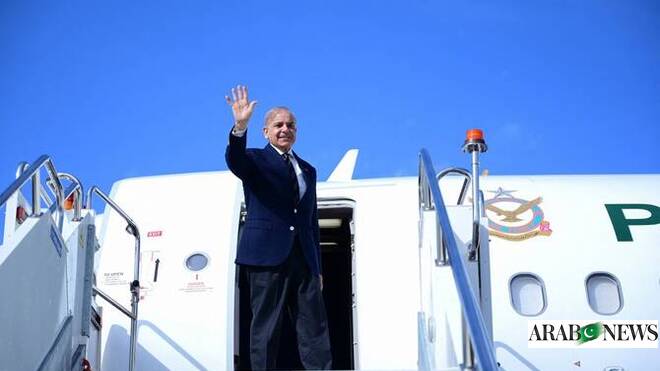
Sharif is scheduled to visit China from May 23-26.
“Pakistan and China have been in close coordination on the standoff in the Middle East and the Gulf,” Pakistan foreign office spokesman Tahir Andrabi told reporters on Friday.
“Yes, this issue will be discussed during the prime minister’s visit,” he added, saying Beijing had supported Pakistan’s diplomatic efforts aimed at ending the crisis.
The comments came as Pakistani Interior Minister Mohsin Naqvi held another round of talks in Tehran this week with Iranian Foreign Minister Abbas Araghchi to discuss proposals aimed at ending the conflict, according to Iranian media reports.
The semi-official Tasnim and ISNA news agencies said Naqvi was facilitating communication efforts intended to establish a framework for ending the war and resolving disputes between Tehran and Washington.
Six weeks after a fragile ceasefire came into effect on April 8, negotiations remain deadlocked over Iran’s uranium stockpile, sanctions relief and Tehran’s control of shipping through the Strait of Hormuz.
US Secretary of State Marco Rubio warned on Thursday there could be no agreement if Iran imposed tolls or restrictions on international shipping through the strait.
“There’s some good signs,” Rubio told reporters. “I don’t want to be overly optimistic … So, let’s see what happens over the next few days.”
US President Donald Trump also reiterated that Washington would not allow Iran to retain highly enriched uranium.
“We will get it. We don’t need it, we don’t want it. We’ll probably destroy it after we get it, but we’re not going to let them have it,” Trump told reporters at the White House on Thursday.
He also criticized Tehran’s position on the Strait of Hormuz.
“We want it open, we want it free. We don’t want tolls,” Trump said. “It’s an international waterway.”
China and Pakistan have maintained close strategic ties for decades, including cooperation in defense, diplomacy, infrastructure and regional connectivity. Analysts say Beijing has increasingly relied on Islamabad as an important diplomatic channel in the Gulf because of Pakistan’s relations with Iran, China, Gulf Arab states and the United States.
Talks between Sharif and Chinese leaders in Beijing later this month are expected to focus on economic cooperation, regional security and the next phase of the China-Pakistan Economic Corridor (CPEC), Beijing’s flagship infrastructure and connectivity project in Pakistan under the Belt and Road Initiative.