
Day 2 of Goafest 2026 focused heavily on AI, consumer data, storytelling and the future of advertising, with industry leaders discussing the impact of AI on marketing, media and brand building.
One of the opening sessions, titled ‘AI Washing: The Truth About AI’, examined the gap between adopting AI tools and becoming fully AI-driven organisations. The panel featured Gulrez Alam, Chief Revenue Officer, Affle; Niraj Ruparel, Creative Technology Lead, WPP & WPP Media; and Smriti Mehra, CEO, English and business news, Network18. The panel was moderated by Shubhranshu Singh, Member of the Board of Directors, Effie LIONS Foundation & Forbes Most Influential Global CMO 2025.
Alam noted, “AI is meaningful only when it delivers results and efficiency for clients; creativity and planning mean little without outcomes. Built on the principle of ‘garbage in, garbage out,’ AI depends on quality data that must evolve from a rearview mirror into a GPS. Moving beyond screens through wearables and AI-powered glasses, AI will increasingly understand emotions, gestures, and intent while enabling instant outputs in a “zero to fast” world. As automation accelerates and bots dominate online traffic, advertisers will need to identify real human audiences while also engaging with AI bots working on behalf of humans.”
Ruparel continued that AI was accelerating innovation and enabling faster prototyping, but added that human creativity would remain essential. She said, Emphasising AI’s role in accelerating innovation while underscoring the enduring importance of human creativity and collaboration, Niraj Ruparel, Creative Technology Lead, WPP & WPP Media, said, “AI is unlocking massive opportunities for rapid prototyping and innovation, enabling creative and tech teams to build solutions faster and democratise access to creativity at scale, including for underserved audiences. Combined with faster internet, AI will accelerate immersive, personalised 3D and spatial experiences and help brands reach underserved and rural audiences. However, technology alone is not enough – human creativity and original thinking will remain the true differentiators. As AI-generated experiences, synthetic media, and emotion-aware systems evolve, successful adoption will depend on collaboration between creative teams, technologists, strategists, clients, and consumers, with India’s AI future driven by scalable platforms powered by creativity and collaboration.”
Smriti Mehra, added “AI will transform news from information dissemination to intelligence-led storytelling, making content more personalised and multilingual, while human editorial judgment remains critical. Most companies today are still in the experimental or partially deployed stage of AI adoption, even as businesses increasingly use AI to improve outputs, increase speed, reduce costs, and drive revenue. The media will continue questioning and verifying corporate AI claims and ‘AI washing,’ while brands face the growing challenge of engaging the remaining genuine human audience online. As digital ecosystems evolve, premium experiences may increasingly move behind paywalls, and brand messaging and consumer engagement models will continue to transform.”
Google also held a keynote session on AI agents and automation, led by Satya Raghavan.
Raghavan noted consumer behaviour was changing rapidly and increasingly moving beyond traditional digital funnels. “Consumer needs are changing rapidly, with ‘an app for everything,’ and behaviour has moved beyond the traditional funnel as people simultaneously search, stream, scroll, and shop. AI-powered search and ad ecosystems are enabling more contextual and personalised experiences, in a world where six generations can coexist in one household – from Boomers to Gen Beta – and where ‘there is an agent for that’ is becoming the central idea.”
“An agent is essentially a system that performs tasks on behalf of someone else, and in that sense, agencies have always functioned as agents by solving business problems for brands and consumers. AI agents are valuable only when tied to the right use case, helping automate repetitive tasks so humans can focus on higher-value creative work. Brands, platforms, and consumers are increasingly interacting through interconnected agents and sub-agents, from shopping agents that compare and transact on users’ behalf to advertising agents that optimise campaigns in real time”, he added.
Speaking on the transition from generative AI to the emerging agentic era, he added, “We are now moving from the generative era to the agentic era, where you no longer need to know coding – only how to communicate and instruct. The goal of AI is not to replace humans but to help them work faster and smarter, creating opportunities for marketers, agencies, and creators to build specialised agents across workflows. With platforms like Google and partners already deploying ready-to-use agents across media, creative, and advertising functions, the future of marketing will revolve around identifying the right use cases and building intelligent agents around them.”
Another panel, “The Hook: The Craft, The Culture, The Conversation”, focused on storytelling, virality and audience engagement. Speakers included Darshana Shah, Chief Marketing Officer, Aditya Birla Capital; Rahul Kanwal, CEO & Editor in Chief, NDTV; Rana Barua, Group Chief Executive Officer, Havas India, SE Asia & North Asia (Japan & South Korea); Rohit Kapoor, Chief Executive Officer, Swiggy; and Sam Balsara, Chairman, Madison World. The session was moderated by Alex Matthew, Associate Executive Editor, NDTV Profit.
Speaking about the evolving realities of consumer attention, media consumption, and the growing need for always-on brand engagement, Darshana Shah, said, “Media fragmentation and shrinking attention spans are forcing marketers to constantly unlearn and relearn, as consumers increasingly scroll, stream, search, and shop simultaneously. While branding still depends on what a brand stands for in the consumer’s mind, brands today need an immediate hook to capture attention within seconds. Storytelling remains relevant, but campaigns must capture attention within the first few seconds, with ideas rooted in long-term brand positioning and deep consumer understanding. Moment marketing works best when brands fit naturally into cultural conversations, while content now drives memorability and stickiness, especially among younger audiences. Moment marketing works best when brands fit naturally into cultural conversations, while always-on, relevant content now drives memorability, engagement, and commerce in real time.”
Highlighting the growing role of cultural relevance, virality, and real-time audience engagement in modern brand-building, Rahul Kanwal, said, “Cultural moments today can emerge instantly on social media and become massive movements overnight, as seen with phenomena like the ‘Cockroach Janta Party’ gaining traction within hours and viral moments like ‘Melody’ becoming branding that money cannot buy. Brands today need to quickly recognise and ride such unexpected viral waves, as storytelling shifts from traditional campaigns to real-time hooks and engagement. AI and prompt engineering are also challenging traditional creative hierarchies, enabling younger creators using AI tools to compete with seasoned professionals. Overall, the advertising world is moving from campaign-led storytelling to culture-led storytelling.”
About evolving intersection of AI, culture, and brand storytelling, Rana Barua, added, “AI is creating a new model of storytelling, engagement, and audience conversations, while consumer behaviour is increasingly shaped by social media and cultural trends. Brands today must decide whether they want to be meaningful or merely desirable, because without emotional connection or relevance in people’s lives, no amount of marketing can succeed. While platforms and formats continue to evolve, brand building and storytelling remain at the core. AI can facilitate conversations and execution, but it cannot create original ideas or cultural understanding — the real ideas still come from humans who understand culture, behaviour, and context. The real challenge is not just execution, but finding the right idea and authentic audience connection, which is why AI will not replace human creativity or emotional intelligence.”
Rohit Kapoor, noted, “People today forget and forgive quickly in the era of virality, so while execution is fast and chaotic, strategy must remain consistent and rooted in what doesn’t change in human behaviour. Gen Z is not a single audience, and brands must balance virality with clear guardrails, embracing trends quickly but dropping them just as fast, since today’s ads may last only around 10 days. Long-term brand building still requires consistency as brands are built over years while trends are built in days, and although AI is democratising creativity and reducing costs, human creativity remains irreplaceable.”
Discussing about the evolving balance between brand building, performance marketing, and the role of AI in advertising, Sam Balsara, added, “Consistency is what makes campaigns memorable over time. Many brands today are overfocused on performance marketing at the cost of brand building, even though performance marketing is important and cannot replace branding completely. The ideal approach is to balance branding and performance marketing. Ads today also need far more frequent refresh cycles than earlier, when campaigns could run for years; now they may need to change every month. AI can help reduce content production costs and improve speed, but human creativity remains irreplaceable despite these advancements.”
Adding an analytical lens to the day’s agenda, Comscore presented a keynote session titled ‘AI, Audiences & Cross-Platform Clarity’. Smriti Sharma, Executive Vice President, Analytics & Managing Director, Custom IQ, Comscore, highlighted the growing need for measurement transparency and audience understanding across platforms in a world increasingly shaped by AI-driven consumption and fragmented media behaviours.
Sharma said, “Consumer behaviour in India is evolving rapidly, with users increasingly outsourcing decisions to AI, which is becoming the recommender, influencer, and decision-maker across the consumer journey. Consumers are no longer searching traditionally but asking conversational queries, while AI tools are accelerating creation, shrinking attention spans, and reshaping discovery across fragmented platforms. In this ‘jugaad ecosystem,’ Indian users trust creators and communities over polished advertising, pushing marketers to move from placement-led strategies to influence-led ecosystems powered by connected data.”
Another panel – ‘The Resets That Shaped Indian Advertising – And the One We’re Living Through Now’, featured, Dheeraj Sinha, Chief Executive Officer, McCann Group; and Annurag Batra, Chairman and Editor-in-Chief of BW Businessworld group and the Founder and Editor-in-Chief of the exchange4media group.
Speaking about the future of India’s advertising and marketing ecosystem, Annurag Batra, said, “The Indian advertising industry is expected to grow from Rs 75,000 crore to over Rs 2 lakh crore in the coming years, as advertising is not dying-more businesses and brands are using it to drive growth. The agency of the future will look very different from today’s traditional structures, evolving into marketing transformation companies that integrate strategy, media, content, AI, digital, and consulting at the intersection of Silicon Valley technology, advertising creativity, and entertainment. The strongest agencies will be those who combine these worlds while reclaiming storytelling as a core strength, even as many storytellers now exist outside agencies. GCCs will emerge as a major growth engine for India’s marketing services industry, with global networks increasingly building capabilities here, while the ecosystem becomes more entrepreneurial, agile, and less hierarchical. AI will improve productivity, but originality, authenticity, and strategic thinking will remain distinctly human, making uniqueness and creative leadership more valuable than ever. Branding will only grow in importance, as excessive reliance on performance marketing is unsustainable—brands are built over years, while trends are built in weeks.”
Speaking about the future of advertising, agencies and AI-led transformation, Dheeraj Sinha, said, “Every few years, advertising is declared dead, and AI is expected to replace jobs, yet India remains one of the world’s most optimistic advertising markets, driven by a fast-growing consumer economy and rising demand for new brands. Advertising is shapeshifting, but the opportunity is only expanding, requiring agencies to think beyond short-term cycles and focus on long-term creativity and brand building. AI is simplifying operations and enabling leaner, more flexible agency models, allowing creators to independently produce and distribute content while agencies focus on consumer understanding, strategy, and impactful storytelling. India is also emerging as a major global hub for marketing and creative services, powered by growing talent, technology, and entrepreneurial energy.”
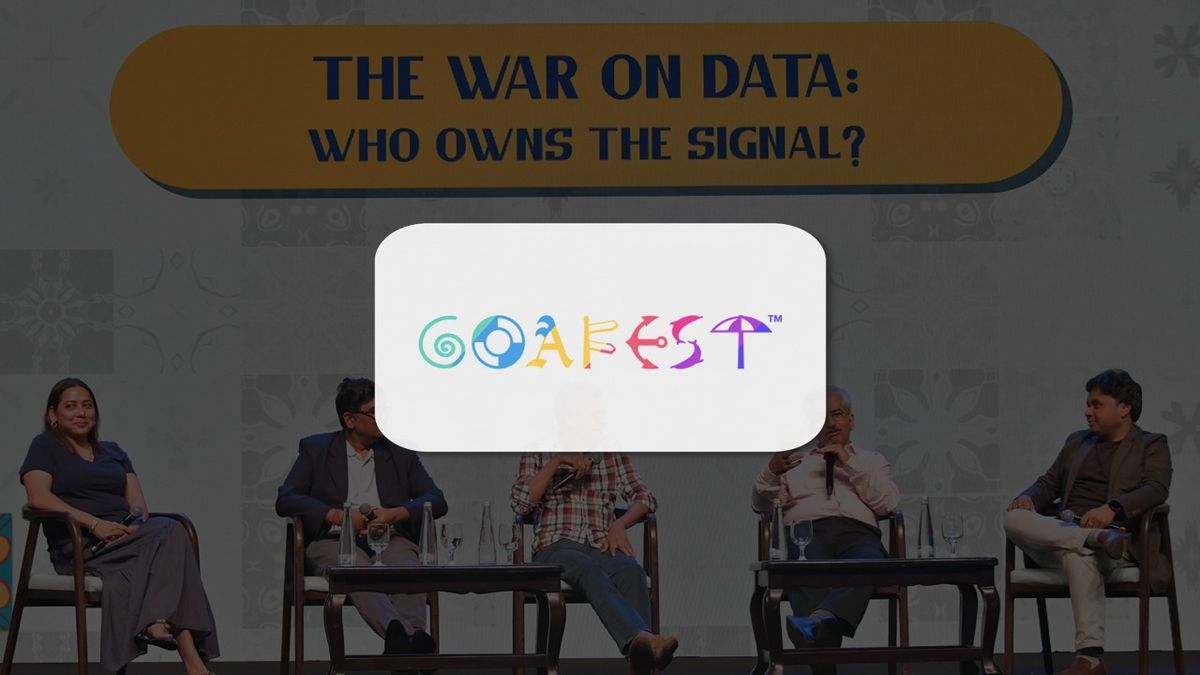
The first half of Day 2 concluded with Saptharushi Presents ‘THE WAR ON DATA – Who Owns the Signal?’, a discussion around consumer data, privacy, digital ecosystems and ownership.
The session featured Mayank Shah, Vice President at Parle Products; Anjali Madan, Director, Consumer Experience, Global Marketing, Mondelez International; Sanjay Sindhwani, CEO, Indian Express Online; and Saikat Sinha, Director, Consumer Experiences, The Coca Cola Company. The session was moderated by Gowthaman Ragothaman, Founding Chief Executive Officer, Saptharushi.
The panel delved into the ongoing battle for data ownership, the future of consumer trust, and the growing importance of first-party data strategies in the digital economy.
Talking about the data-driven customisation, Mayank Shah said, “Data-driven customization works best for high-involvement categories, while FMCG still relies heavily on mass branding and top-funnel awareness. Bottom-funnel targeting is easier, but building emotional consumer connections remains the bigger challenge, as real consumption behaviour is still difficult to decode through data alone. Communities and on-ground market understanding continue to play a critical role in communication planning, even as segmentation becomes more advanced. The DPDP rollout is a positive step, making explicit consumer consent, transparency, and responsible data usage increasingly important for brands and agencies.”
Anjali Madan, Director, added, “Performance marketing and brand building should not be treated separately, as consumers don’t distinguish between performance and equity marketing. Over-focusing on ROAS and conversions can weaken long-term brand equity and increase future acquisition costs, making it critical for CPG brands to view marketing spends as one consolidated investment. Real consumer understanding comes from brand interactions, not bought third-party data, while strong engagement builds richer first-party data over time. Agencies’ future value will increasingly depend on proprietary data ecosystems, consumer intelligence, and consent-led data practices, especially as DPDP and privacy regulations strengthen governance. Brands must avoid chasing only short-term metrics and keep long-term brand building central.”
Speaking about how publishers are adapting to the evolving data and privacy ecosystem, Sanjay Sindhwani said, “Indian publishers are moving from anonymous audiences to first-party data ecosystems built through sign-ups, subscriptions, whitepapers, and downloads, as owning customer relationships becomes critical. Publishers realised that while platforms and tools like Google Analytics offered scale and insights, they did not provide ownership of consumer data. Subscription models further accelerated the need to deeply understand audience behaviour, even as interoperability and data collaboration remain major industry challenges. Building strong first-party data systems requires long-term investment, and the future will increasingly depend on consent-led, authenticated consumer ecosystems under evolving privacy regulations.”
Saikat Sinha added, “Beverage brands are built on deep consumer and cultural understanding, with ecosystems across retail and distribution playing a critical role. Consumers today want active participation with brands as they simultaneously stream, scroll, shop, and engage, making brand-led communities increasingly important. Real-time signals, contextual understanding, and partner ecosystems help brands identify the right consumer moments, especially in categories driven by experiences and occasions. At the same time, DPDP preparedness is pushing companies to strengthen data responsibility and protection practices.”
Day 2 also featured a series of masterclasses that provided insights into creativity, storytelling, media innovation, and consumer engagement.
LinkedIn presented a masterclass titled ‘The Creator Playbook: How to build content, credibility and community on LinkedIn’, led by Preethi Ramamoorthy, Managing Editor (Communities) & Benjamin Joy, Agency Lead. The masterclass also featured a special guest speaker, Abhishek Patil, Co-founder & Chief Revenue Officer, GrowthX.
The Asian Federation of Advertising Associations hosted a masterclass titled ‘Algorithm of the heart, stories machines can’t tell’ led by Bharat Avalani, Founder and CEO, Connecting the Dots Consultancy Malaysia & Global Partner Anecdote, exploring the enduring power of human emotion and storytelling in an increasingly AI-driven world.
MediaKart conducted a masterclass on ‘Creative That Connects: Leveraging Rich Media in the Right Context’ led by Shahad Anand, Business Head, while Mudra Institute of Communications Ahmedabad (MICA) hosted a thought-provoking session titled ‘Mastering Content in an Attention Deficit Economy’ by Falguni Vasavada, Head – Academics, School of Applied Creativity. Adding another dimension to the discussions around consumer connection and brand relevance, Shaziya Khan, Brand Communication Strategist, Insight Chaser, Author, led a session titled ‘Small Is The New Big: The Connection Brands Are Missing’.