
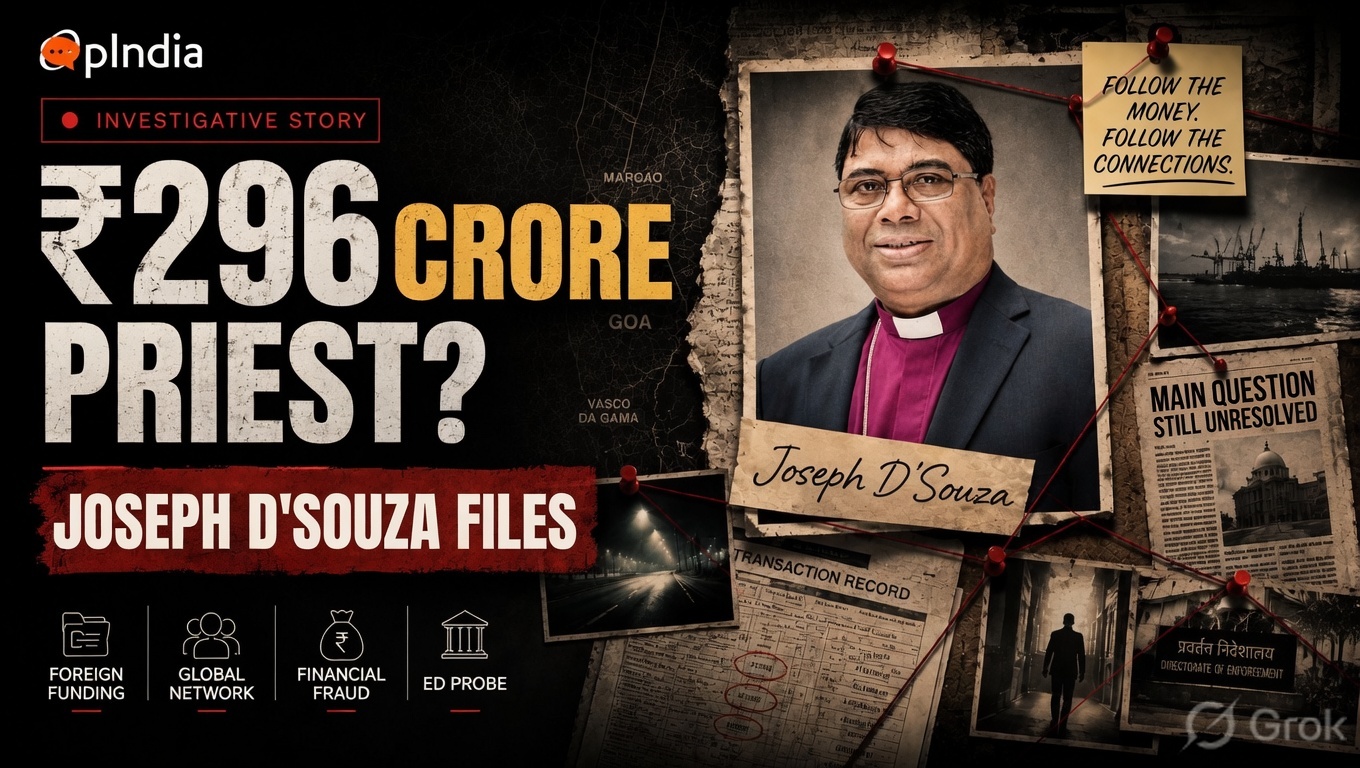
Following the implementation of stringent laws in India, such as the Foreign Contribution Regulation Act (FCRA) and the Prevention of Money Laundering Act (PMLA), several networks linked to foreign funding have come under scrutiny. As legal action intensified, some groups allegedly began portraying themselves as victims and building narratives against India on international platforms.
In this context, the name of Archbishop Joseph D’Souza has also surfaced. D’Souza compared financial investigations in India to the persecution of Jews in Nazi Germany. While presenting himself as a voice for Dalits and marginalized communities, questions have repeatedly been raised regarding foreign funding, financial irregularities, and actions taken by investigative agencies against him. In this report, we will examine every layer of Joseph D’Souza’s past, including allegations surrounding family fraud, financial scandals, investigations by the Enforcement Directorate (ED) and CID, political connections, and what critics describe as his anti-India toolkit.
Joseph D’Souza’s past: Family background and the truth about conversion
Joseph D’Souza and his Western associates have frequently promoted a narrative on international platforms that they belong to oppressed, backward, or untouchable communities in India who later converted to Christianity. This portrayal is often used to establish themselves as the “natural and authentic representatives” of India’s Dalits and to attract sympathy from foreign donors. However, according to historical, genealogical, and documentary claims presented by critics, this narrative is misleading and part of a carefully constructed image.
Born into an elite Christian family and the reality of “Christian Ghettos”
Joseph D’Souza was not born into a poor, marginalized, or socially disadvantaged family. Rather, he was born into a highly affluent, economically strong, and traditionally upper-caste Christian family. On several occasions, he himself has reportedly acknowledged that he spent his childhood in “Christian ghettos”, distinct and prosperous Christian settlements surrounded by lower-caste and poor Dalit populations. In other words, from childhood he allegedly lived a privileged life separate from the oppressed communities whose image he is now accused of appropriating.
The genealogical background: Goa’s “Goud Saraswat Brahmins”
According to family histories and genealogical records cited by critics, there is no personal history of Joseph D’Souza himself converting from Hinduism to Christianity. His family has been Christian for generations. They are originally descendants of the well-known “Mudartha” family of Moodubelle in Karnataka.
Research into the family lineage reportedly suggests that they were originally connected to Goa’s upper-caste Goud Saraswat Brahmin community. During the period of Portuguese rule, it is claimed that this Brahmin family was forcibly converted to Christianity.
Educational background and family structure
Joseph earned a bachelor’s degree in Chemistry from Karnataka University. He later became fully involved in missionary activities. He obtained a Master’s degree in Communication from the Asian Theological Seminary in the Philippines. Subsequently, he was awarded an honorary Doctor of Divinity degree by the Gospel for Asia Biblical Seminary, which critics argue is often used within such networks as a means of strengthening influence and status.
Joseph married a tribal woman named Maryam, a relationship that reportedly faced opposition in its early stages from his family and friends due to his upper social background. Today, critics claim that this family structure has evolved into what resembles a family-run corporate setup. His daughter, Beryl D’Souza, serves as the Global Director for Medical and Anti-Human Trafficking initiatives at the Dignity Freedom Network (DFN), an organization run by Joseph and supported through foreign funding, where she reportedly receives substantial compensation and benefits.
OM International, OM India, Good Shepherd, and DFN: A global triangular structure
To understand Joseph D’Souza’s network, it is important to examine the global and domestic structure of the organizations associated with him. Critics argue that this is not merely a religious institution or a conventional church setup but a multi-layered and highly sophisticated corporate missionary network.
A: From OM International to OM India
Joseph D’Souza began his career with the Indian division of Operation Mobilization (OM International), a globally influential missionary organization founded by George Verwer. OM International is a vast global network registered under the UK Charity Commission.
D’Souza rose through the ranks to become International Vice President of the global organization and later became CEO of its Indian division, OM India, in 2012.
In 2014, according to critics, OM India took a strategic step by technically and legally separating itself from its international parent organization to avoid scrutiny by Indian security agencies. This newly independent entity was rebranded as the “Good Shepherd Church of India.” Through this structure, a parallel network of churches and schools was reportedly established across India, receiving direct financial support from foreign sources.
B: Dignity Freedom Network (DFN)
To build international narratives concerning India and continue fundraising efforts without obstacles, Joseph D’Souza co-founded the Dalit Freedom Network in the United States in 2002. Later, when Indian security agencies allegedly became more attentive to activities associated with the organization, its name was changed to the Dignity Freedom Network (DFN).
Today, this network operates major branches in the United States (DFN USA), Australia (DFN Australia), Canada, and the United Kingdom. According to critics, websites and promotional material associated with these organizations present a highly negative picture of India, claiming that “Dalits and Christians in India are being killed like insects,” while portraying donations to DFN as the primary means of addressing such issues.
C: DFN’s role in the “Breaking India” ecosystem
In the well-known book Breaking India, researchers and authors Rajiv Malhotra and Aravindan Neelakandan provide a detailed investigative analysis of Joseph D’Souza’s Dalit Freedom Network (DFN).
The book argues, using academic references and supporting material, that DFN is not merely a human-rights organization but part of a broader Western geopolitical intervention framework allegedly aimed at influencing India’s internal dynamics and sovereignty. According to the authors, the network uses the language of “human rights” and “Dalit empowerment” as a vehicle for channeling foreign funds into programs and seminars that critics claim are designed to distance Indian youth, particularly socially disadvantaged communities, from their national and cultural identity, create hostility toward their own civilization, and deepen social divisions within the country.
Serious financial crimes and fraud allegations
Joseph D’Souza’s critics argue that his public image came under major scrutiny after the Telangana CID and the Enforcement Directorate (ED) filed charges in connection with serious allegations involving money laundering and financial misappropriation.
According to findings cited by investigative agencies, Joseph D’Souza and his son Josh Lawrence D’Souza allegedly diverted approximately Rs 296.6 crore in foreign funds, originally raised for the free education and welfare of poor Dalit children, into private bank accounts, fixed deposits, and luxury real-estate investments through fake invoices and shell companies.
To understand the broader allegations, the following examples outline the key scams and the alleged modus operandi identified by investigators:
Tsunami Relief Fund misappropriation
What was the allegation?
Following the devastating 2004 tsunami, approximately Rs 4–5 crore was reportedly raised from foreign donors for the rehabilitation of displaced fishermen and affected coastal communities.
How the alleged manipulation was carried out (Modus Operandi):
The funds were intended for constructing houses and providing boats for fishermen affected by the disaster. However, according to investigators, little or no relief work was carried out on the ground. Authorities alleged that D’Souza’s network created fake invoices in the names of companies and vendors that either did not exist or had no genuine involvement. Through these fabricated bills, investigators claim that the money was withdrawn and diverted elsewhere.
Bible Distribution Scam Allegations
What was the scam?
The network reportedly received Rs 5.9 crore in foreign funding for a specific and legally approved purpose: printing Bibles and other religious material for free distribution in rural and tribal regions across India.
How the alleged manipulation was carried out (Modus Operandi):
According to investigators and critics, charitable funds were allegedly diverted for commercial use. D’Souza reportedly established a business entity called OMBF (OM Books Foundation). Instead of distributing the Bibles free of cost as intended, the printed materials were allegedly sold through this foundation at commercial market rates.
Investigators claimed that materials financed through charitable donations for free distribution generated an unauthorized commercial profit of approximately Rs 9.7 crore. Critics argue that such practices, if proven, would constitute violations of FCRA regulations and tax laws.
Alleged international fundraising misuse through the “Jogini” narrative
What was the scam?
It is one of the most controversial allegations linked to the network that says vulnerable children were used as emotional tools to maximize international sponsorships and donations.
How the alleged manipulation was carried out (Modus Operandi):
The Jogini or Devadasi system has historically existed as a social practice and has, over time, been portrayed by many scholars and activists as involving the exploitation of women associated with temples.
According to investigators and critics, D’Souza’s network allegedly photographed ordinary economically disadvantaged students studying in Good Shepherd schools and used those images in fundraising campaigns targeting affluent Christian donors abroad.
These children were allegedly presented to donors as “Jogini children,” described as children born into families associated with religious and sexual exploitation. Foreign donors were reportedly told that these children required urgent rescue and rehabilitation support.
Through this narrative, investigators allege that an additional $27–33 per child per month was raised in sponsorship funds, with accusations that portions of these funds were redirected into trusts linked to D’Souza and his family.
Critics further argue that the international portrayal of the Jogini issue reflects broader debates surrounding colonial-era narratives, where certain traditions associated with Sanatan practices were interpreted and represented as systemic forms of exploitation, and they allege that such narratives continue to be used by some actors for fundraising purposes.
Misappropriation allegations involving school fees and government funds (Fee Siphoning)
What was the allegation?
Critics describe this as a “double-revenue model,” alleging that money was obtained both from foreign donors and from the same families whose children were being showcased as beneficiaries.
How the alleged manipulation was carried out (Modus Operandi):
On international platforms, DFN reportedly claimed that it was providing 100% free education, accommodation, and food to Dalit children in India, and raised substantial annual funding on that basis.
However, according to investigators, the situation on the ground was different. Students attending Good Shepherd schools were allegedly charged tuition fees, school uniform costs, and transportation fees.
Additionally, investigators alleged that reimbursements and subsidies received under India’s Right to Education (RTE) framework, including government support intended for educational expenses, were either omitted from school audit records or diverted into private accounts.
Alleged FCRA violations through fake invoices (post-ban siphoning)
What was the allegation?
According to investigators, even after the Ministry of Home Affairs (MHA) suspended and later cancelled the FCRA licenses of key organizations associated with the network for alleged regulatory violations, foreign funds reportedly continued entering India through indirect channels.
How the alleged manipulation was carried out (Modus Operandi):
The cancellation of FCRA licenses meant that the organizations could no longer directly receive foreign donations. Investigators alleged that D’Souza then used his commercial entity, OMBF (OM Books Foundation), as an alternative route.
According to allegations, inflated and fabricated invoices for printing and publishing services were generated and sent to associated or allegedly affiliated organizations overseas. These transactions were presented as legitimate commercial activities, creating the appearance that foreign organizations had commissioned books and publications. Investigators claim that this mechanism was used to continue routing foreign funds into India despite restrictions on direct foreign contributions.
Enforcement Directorate (ED) action and property seizures
What was the allegation?
Investigators alleged that approximately Rs 296.6 crore generated through the above-mentioned activities was laundered through investments in real estate and other assets.
How action was taken:
While investigating under the Prevention of Money Laundering Act (PMLA), the Enforcement Directorate (ED) reportedly found that Joseph D’Souza, his son Josh Lawrence D’Souza, and close associates had acquired expensive land parcels, commercial properties, and luxury villas using funds allegedly linked to these activities.
As part of its action on what it classified as “proceeds of crime,” the ED reportedly attached and froze 12 major immovable properties whose combined market value was estimated at over Rs 15 crore.
The alleged operational model of this financial network was straightforward but sophisticated: portray India’s poverty and social problems in alarming terms to foreign audiences in order to attract donations, then allegedly divert those funds through paper transactions and fabricated invoices into private assets and an affluent lifestyle rather than using them for the intended beneficiaries.
Political connections and the Indian Left-Liberal ecosystem
Joseph D’Souza’s critics argue that his influence extends beyond religious activities and that he has maintained close links with sections of India’s political and media ecosystem. They claim that whenever legal action intensifies around financial allegations, political support systems become active in framing such actions as politically or ideologically motivated.
Ideological alignment with Sonia and Rahul Gandhi
Joseph D’Souza’s association with senior Congress leadership goes back many years.
Following the 2004 general election, when the government led by Atal Bihari Vajpayee was defeated and the United Progressive Alliance came to power under the leadership of Sonia Gandhi, D’Souza reportedly wrote to church networks in the United States describing the outcome as “Divine Justice” and “a great miracle.”
At that time, D’Souza was serving as the global president of the All India Christian Council. According to Breaking India, these claims and related documentation are discussed in Chapter 8 of the book.
It also point to more recent developments as evidence of continued political alignment. During debates around reforms concerning Waqf administration, Rahul Gandhi echoed concerns raised by some bishops and church groups, stating that after the Waqf Bill the government might potentially target church properties.
Such political statements serve to frame ongoing ED and CID investigations involving figures like Joseph D’Souza as issues of “religious persecution,” thereby creating a protective political narrative. However, this remains a matter of political interpretation and competing viewpoints rather than an established legal conclusion.
Platforming by The Wire and Siddharth Varadarajan
Following amendments to India’s FCRA framework aimed at tightening oversight of foreign funding and addressing concerns around illegal conversions and money laundering, critics allege that the digital news platform The Wire provided a platform to Archbishop Joseph D’Souza to challenge the government’s actions.
According to critics, The Wire co-founder Siddharth Varadarajan enabled D’Souza to present his views through a special interview format.
During a lengthy video interview with The Wire, Joseph D’Souza reportedly described the financial regulations passed by India’s Parliament as a “direct government seizure of church properties.” According to critics, he also appealed to the international community, particularly the United States and European countries, to intervene regarding India’s regulatory framework and exert diplomatic or economic pressure on the Indian government. The interview on The Wirewas conducted by senior journalist Karan Thapar.
Formation of the National Federation of Churches in India (NFCI): A pressure group
Joseph D’Souza’s lobbying efforts also contributed to the formation of the National Federation of Churches in India (NFCI), a platform that brought together denominations including Catholic, Protestant, Evangelical, and Pentecostal churches, despite longstanding theological differences among them.
Anthony Poola was appointed as the federation’s president.
The organization’s core objective extends beyond religious coordination and reform. According to them, the federation functions as a coordinated political and social pressure group intended to oppose anti-conversion laws enacted in several Indian states and challenge the central government’s FCRA regulations, with the broader aim of protecting institutional and financial interests. These claims, however, reflect the interpretation of critics and remain matters of political and ideological debate rather than established judicial findings.
Joseph D’Souza’s statements, videos, and blogs criticizing India
Joseph D’Souza has consistently used international media outlets, American think tanks, and digital platforms to portray India as an “intolerant,” “anti-Christian,” and “fascist” nation. According to these critics, an analysis of his public statements, video interviews, and blog posts reveals what they describe as a broader anti-India narrative strategy.
1. Statements on global media and comparisons with Nazi Germany
Remarks on CBN News
In an interview with the American Christian media outlet Christian Broadcasting Network (CBN News), Joseph D’Souza reportedly compared India’s financial regulations, particularly FCRA amendments, with the systematic persecution of Jews under Adolf Hitler in Nazi Germany.
Critics view such comparisons as an attempt to portray India’s democratic institutions and legal framework in a negative light before international audiences.
Characterization of India as a Nation Built on Oppression
In appearances on the Canadian missionary television program 100 Huntley Street and in his video series Dalit Freedom Part 2, D’Souza reportedly described India’s ancient civilizational and social history as one primarily defined by oppression and social hierarchy.
Critics argue that such presentations simplify and negatively characterize India’s historical legacy for Western audiences while simultaneously portraying Christianity as the sole source of humanitarian values and reform, thereby strengthening missionary narratives.
2. Criticism of the Indian Judiciary
When the Supreme Court of India and various High Courts upheld the constitutional validity of state laws aimed at restricting conversions carried out through inducement, fraud, or coercion, D’Souza reportedly took a strongly critical position toward the judiciary.
In public video statements, he allegedly characterized elements of the Indian judicial system as being influenced by a majoritarian agenda.
Critics argue that beyond the direct criticism of judicial decisions, D’Souza attempted to introduce religious language and biblical references into discussions surrounding Indian legal processes.
According to this interpretation, the broader objective was to frame legal investigations and regulatory scrutiny involving his network not merely as legal matters, but as forms of religious persecution directed against Christian institutions. Critics contend that this creates a narrative environment in which ordinary legal proceedings involving financial allegations can be portrayed as ideological or faith-based conflicts.
3. Sharing platforms with Kancha Ilaiah Shepherd
Joseph D’Souza has frequently appeared on international forums and podcasts alongside Kancha Ilaiah Shepherd.
Critics describe Kancha Ilaiah as a controversial figure known for strong critiques of Hindu social structures and Indian cultural traditions. They also point out that he has written for NewsClick, a platform that has faced scrutiny in investigations concerning foreign funding allegations.
According to critics, D’Souza and Kancha Ilaiah use international platforms to present critical interpretations of Hinduism, India’s social structures, and Indian culture, while drawing selectively on the ideas of B. R. Ambedkar, Jawaharlal Nehru, and Karl Marx to advance broader ideological arguments concerning India.
Blog Posts and Digital Platforms
Joseph D’Souza reportedly publishes articles critical of Hindi, Indian nationalism, and anti-conversion laws enacted in various Indian states through personal blogs and international evangelical portals.
In his essays, D’Souza advocates for an unrestricted right to religious conversion and opposes limitations on missionary activity, including regulations concerning the use of foreign funding. These positions remain part of broader political and ideological debates surrounding religious freedom, conversion laws, and foreign-funded activism in India.