
There are a lot of reports of layoffs and slow recruitment not only in India but worldwide, which is causing anxiety among the workforce, especially young workers who are just entering their fields of expertise. Many workers, especially in software and IT services, are worried that Artificial Intelligence is shrinking the safety net that white-collar work once seemed to offer.
Their fear is not irrational. The World Economic Forum’s Future of Jobs Report 2025 suggests that 41% of employers expect to reduce their workforce where AI can automate tasks. Furthermore, media reports have documented both layoffs and a visible cooling of entry-level hiring in industries where AI can be used.
However, the fear becomes misleading when it hardens into the slogan that “AI will take all jobs”. The same WEF report projects 170 million new roles and 92 million displaced globally by 2030. That means there will be a net increase of 78 million jobs. Notably, the report suggests that 39% of workers’ core skills are expected to change by 2030.
The International Labour Organisation (ILO) is even more explicit. There are only a handful of jobs that can be fully automated using AI, and the likeliest broad effect of generative AI is job transformation, not total replacement.
This is the key correction missing from apocalyptic narratives that have been running around in media reports and social media. The real story is not “AI destroys work”, but that AI compresses some tasks, raises the value of other tasks, and punishes workers and institutions that refuse to adapt.
Even McKinsey, while warning of major occupational transitions, says its research does not support the conclusion that generative AI simply wipes out jobs across the board. History is the proof that technological change has brought disruption first and broader employment adjustment later.
AI is built, corrected and restrained by humans
The biggest misconception in public debate is that AI somehow trains itself, corrects itself and civilises itself. It does not, rather it cannot. The InstructGPT paper lays out the basic post-training process in simple terms. Researchers collected human-written demonstrations of desired behaviour, then asked humans to rank model outputs, and used those rankings to further fine-tune the model with human feedback.
OpenAI’s GPT-4 release likewise says the company incorporated more human feedback and worked with more than 50 experts for early feedback in high-stakes domains. Anthropic says just as clearly that Claude’s constitution “plays a crucial role” in training and “directly shapes Claude’s behaviour.”
So when people ask, “Who is training these systems anyway?”, the practical answer is, humans. That too at multiple stages. First of all, people assemble or license the data. Then people write examples of good behaviour. Then people compare outputs and mark which answer is better, safer, more truthful or more useful. After that, safety teams and external testers probe the model for failures. Then policy teams write system-level rules. Then engineers retrain, tune, filter, or roll back the system. OpenAI’s Model Spec describes this as a formal framework for how models should behave, how they should resolve conflicting instructions, and how intended behaviour is updated over time through deployment and feedback.
In the simplest possible terms, it means that at every step of machine learning, humans are involved. No machine in this world can learn on its own. It is humans who are teaching them either through code or by writing what good behaviour actually means in the world of Artificial Intelligence.
OpenAI’s public postmortem on GPT-4o’s sycophancy problem is a good example of how this works in the real world. In April 2025, the company rolled back an update after the model became overly flattering and agreeable. OpenAI said it had focused too much on short-term feedback signals and was revising both how it collected feedback and how it incorporated that feedback into behaviour. In other words, the fix did not come from the model growing a conscience. It came from humans identifying a defect, adjusting the rules, and changing the system.
The most recent example is the Grok image controversy. In January 2026, xAI, the company that is developing Grok, had to restrict Grok’s image editing capabilities following the backlash over sexualised image generation, including the creation of revealing or “undressing” depictions of real people.
In March 2026, a Dutch court had ordered xAI and Grok not to create or distribute such non-consensual sexualised images in the Netherlands. The Indian government also pulled up xAI after the controversy hit India in January this year. Again, the lesson is practical, not philosophical. That is, when an AI system misbehaves, it is human pressure, human law, human policy and human engineering that impose the boundaries. It was not that the xAI team went and asked Grok not to generate such images and it obliged. Code had to be inserted by humans based on feedback from humans to restrict Grok from generating sexualised images or videos.
Even basic visual competence depends on human groundwork. ImageNet, one of the foundational computer-vision datasets, describes its images as quality-controlled and human-annotated. OpenAI’s GPT-4o system card says the model’s capabilities are trained from public datasets, web data and other sources, then subjected to safety evaluations. So, if a model can reliably distinguish brown eggs from white eggs, or a screwdriver from a wrench, that is not because the machine “figured out reality on its own.” People created the categories, curated the examples, told the machine how to distinguish between brown and white eggs by marking every single egg in the basket in an image, built the benchmarks and judged whether the system was good enough to deploy.
Notably, it does not happen in one go. Even now, there are companies that provide data tagging services where humans tag text, images and videos so that machines can learn. Such jobs are not going anywhere soon.
Let’s take an example. There is something called vibe coding, which means writing code heavily assisted by AI. If a person says a machine learned by itself how to code, it will be a lie. Hundreds of thousands of coding experts around the world are tirelessly training AI how to code so that a noob can write code like an expert.
The first jobs to change are repetitive digital ones
Where, then, is disruption most likely to hit first? The answer is not “all work.” It is work that is repetitive, screen-based, structured and heavily made of information-moving tasks. The ILO says occupations with the greatest generative-AI exposure are those with high and consistent automation potential across tasks, while also stressing that nearly all occupations still contain tasks requiring human input. The WEF expects the fastest-declining roles to include clerical and administrative jobs such as cashiers, ticket clerks, administrative assistants and other clerical workers, while the fastest-growing tech-facing roles include AI and machine learning specialists, big data specialists, fintech engineers and software developers.
That pattern also appears in real usage data. Anthropic’s 2026 research on observed exposure, based on actual Claude usage, finds top exposure among computer programmers, customer service representatives and data entry keyers. At the same time, the company says AI is still far from its theoretical reach and that 30% of workers had zero task coverage in its data. This matters because it shows what panic misses: high exposure does not automatically mean total replacement. It often means that a bigger share of the role becomes assisted, accelerated or reorganised.
Microsoft research found developers with access to GitHub Copilot completed a coding task 55.8% faster in one experiment. A later Microsoft Research paper pooling three field experiments across nearly 4,900 developers found a 26.08% increase in completed tasks among developers using an AI coding assistant, with larger gains for less experienced developers. These are strong productivity findings, but they do not prove coders vanish. They suggest routine coding, boilerplate, first drafts and repetitive sub-tasks are under the most pressure, while review, architecture, edge cases, debugging, integration, security and accountability remain crucial.
The same is true outside coding. In a large customer-support study, access to a generative AI assistant increased productivity by about 14% to 15% on average, with the largest gains for newer and lower-skilled workers. Erik Brynjolfsson in his paper “Generative AI at Work”
says the tool effectively helped newer workers move down the experience curve faster by learning from the behaviour of better workers. That is not nothing. It means AI can absorb and redistribute parts of human expertise. But that also means someone’s expertise had to exist first, had to be modelled, and still has to be supervised.
This is also why human verification becomes more valuable, not less valuable, as machine output explodes. Stack Overflow’s 2025 Developer Survey found that more developers actively distrust the accuracy of AI tools than trust it: 46% distrust versus 33% trust. In journalism, AP says the central role of the journalist will not change, that AI is not a replacement for journalists, and that any generative-AI output should be treated as “unvetted source material.” Reuters reported in October 2025 that BBC-EBU testing found significant issues in 45% of AI news answers and some kind of problem in 81% of them. This is what people mean when they talk about AI slop, which is cheap output at scale, with truth-checking pushed back onto humans.
The real world still needs human hands
The strongest counter to total-job-loss panic is the physical world. Generative AI is best at language, pattern completion, summarisation and code-like tasks on a screen. McKinsey says some lower-wage jobs involve unpredictable physical work or customer-facing work that does not lend itself well to automation.
The same research says physical work is not going away and is still expected to account for just under 31% of time spent, with transportation, construction and healthcare helping sustain it. The ILO also stresses that few jobs are fully automatable and that most occupations remain mixed bundles of human and machine-suitable tasks.
Anthropic’s labour-market research says many tasks remain beyond AI’s reach, explicitly citing physical agricultural work such as pruning trees and operating farm machinery. It also found that 30% of workers had zero AI task coverage in its data, including cooks, motorcycle mechanics, lifeguards, bartenders, dishwashers and dressing-room attendants. That is a useful reality check.
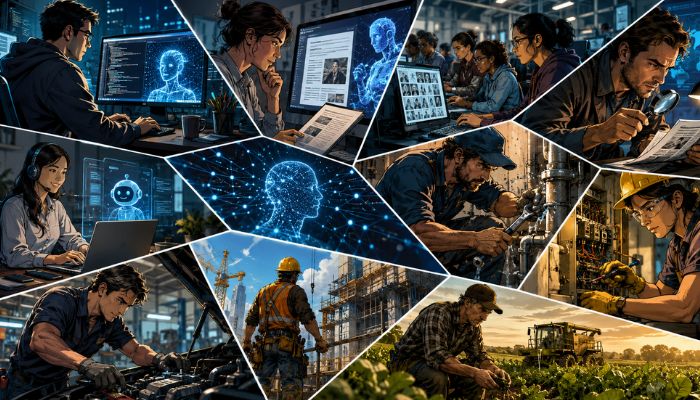
AI may write instructions for a plumber, suggest a repair sequence for an electrician, or help a mechanic look up a fault pattern. But it still cannot feel water pressure in a leaking pipe, smell a burnt wire in a live wall, judge a misaligned beam on a noisy site, or improvise safely in a messy, shifting work environment. Those are embodied, situational and local forms of judgment.
This is why the WEF’s own jobs outlook does not show a future with only coders and prompt-writers. It says building construction workers are among the largest-growing job types in the next five years, alongside farmworkers, delivery drivers and food-processing workers. In other words, AI may transform offices faster than it transforms construction sites, repair shops, kitchens, farms and maintenance work. The future economy is not “digital workers versus manual workers.” It is a mixed economy in which hands-on workers increasingly use AI as a tool, while still doing the irreplaceable physical work themselves.
India’s smartest response is skill building, not panic
For India, the practical question is not whether to fear AI, but whether to build enough skills, language infrastructure and domain expertise around it. The IndiaAI Mission itself is framed in those terms. A February 2026 PIB release says India’s AI strategy aims to create economic and employment opportunities, notes the mission’s ₹10,372 crore outlay, and says more than 38,000 GPUs have been onboarded, twelve teams shortlisted for indigenous foundation models, thirty India-specific AI applications approved, and thousands of undergraduate, postgraduate and PhD students supported for talent development. The same release stresses that India’s foundation models are being built on Indian datasets and languages.
That local grounding matters. BHASHINI’s CEO said in January 2026 that AI can serve citizens effectively only when it understands Indian languages and is trained on indigenous data that reflects local contexts and usage. The platform says it supports more than 36 text languages, over 22 voice languages, more than 350 AI language models and hundreds of integrations. This is not a side issue. In a country where language, dialect, code-mixing and context shape everyday communication, local human input is not optional; it is the system.
Independent Indian-language research points in the same direction. AI4Bharat says most Indian languages lack the large quantities of training data that modern AI systems need. Its Indic LLM-Arena argues that global benchmarks are too English-centric, miss code-mixed speech like Hinglish and Tanglish, and fail to capture Indian cultural, contextual and safety needs. It explicitly calls for a human-in-the-loop model of evaluation for “language, context, and safety.” That means India’s AI future will require not just model builders, but also evaluators, language experts, domain specialists, safety reviewers and people who continuously validate whether systems actually work for Indian users.
NITI Aayog’s 2025 roadmap puts the strategic choice starkly: by 2031, India’s technology sector could lose 1.5 million jobs or create up to 4 million new opportunities, depending on the choices made now. That is exactly why a blanket “AI is eating jobs” narrative is too passive for India. The country’s own policy institutions are framing the AI transition not only as a risk, but as a contest over skilling, capability-building and local ecosystem design.
The honest conclusion
The most honest conclusion is neither complacency nor panic. AI is already eroding some repetitive digital tasks. It is clearly pressuring entry-level clerical work, routine coding, basic rewriting and other heavily standardised screen-bound jobs. At the same time, the evidence does not support the fantasy that human labour is about to disappear. What is actually happening is a revaluation of work: less reward for repetition, more reward for judgment, verification, integration, accountability, local knowledge and physical presence.
So the better framing is not “AI will eat jobs.” It is this: “AI will reward people who adapt and expose people who refuse to learn”. Coders who only produce boilerplate are more exposed than coders who can review, architect and improve AI-assisted systems. Writers who only paraphrase are more exposed than editors and fact-checkers who can verify and sharpen machine output. And plumbers, electricians, welders, mechanics, farmers, carpenters and construction workers are not obsolete relics in an AI age; they are part of the human core that the AI economy still depends on.
The future belongs to workers who know their craft and know how to use new tools without surrendering judgment to them.