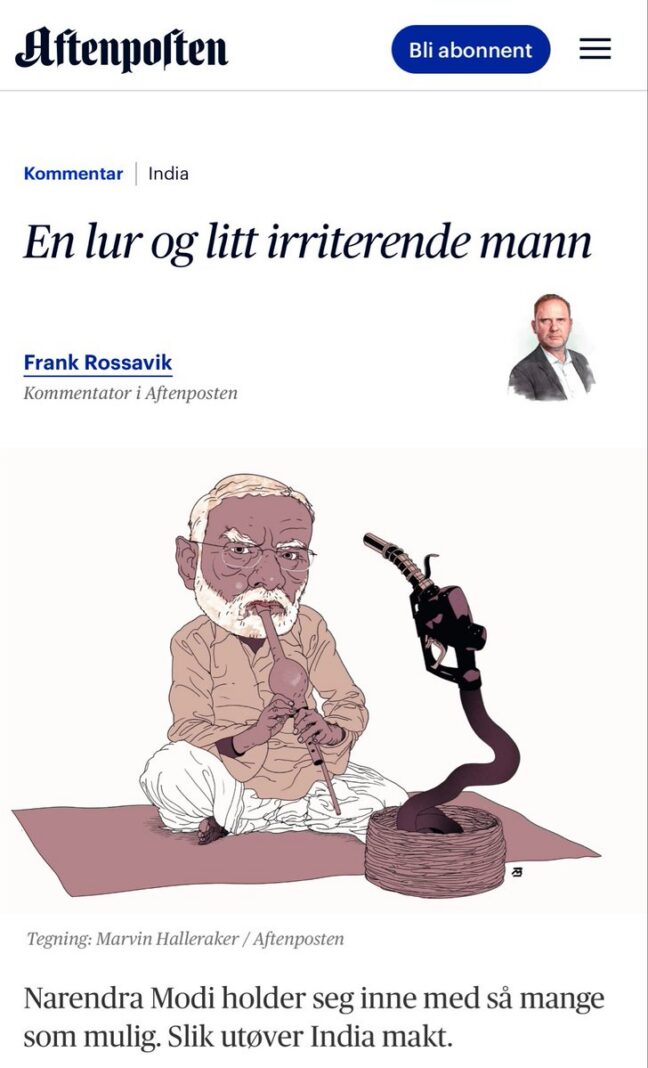
Norway’s Aftenposten has offered a revealing reminder that despite repeated lectures from sections of the Western media on tolerance, diversity and cultural sensitivity, old prejudices have not entirely disappeared. Under the guise of political commentary, the newspaper published a cartoon depicting Indian Prime Minister Narendra Modi as a “snake charmer” with a headline describing him as “a sneaky and slightly annoying man” during his visit to Oslo.
The cartoon attempted to make a geopolitical point, but in doing so, it ended up exposing something far more significant: the persistence of an old and deeply patronising lens through which India continues to be viewed by parts of the Western commentariat and the deep-rooted racism towards countries that once lived under the yoke of European colonialism.
Let us be clear at the outset. Political criticism is not the issue here. Democracies thrive on criticism. Heads of governments across the world, whether in India, Europe or the United States, are routinely scrutinised, mocked and criticised by journalists, commentators and satirists. PM Modi, like any other political leader, is not beyond criticism. In fact, he has been on record to encourage criticism, viewing it as essential for a healthy democracy and a tool to keep the government accountable. His policies, his diplomacy and his governance record can all be debated and challenged. That is not merely acceptable; it is essential in a democratic society.
But Aftenposten did not merely criticise Modi’s politics. It chose to reduce India itself into a colonial stereotype. It chose the image of a snake charmer, a visual trope that for generations was used by outsiders to portray India as an exotic, primitive and backward civilisation. This is where the problem lies. Satire is expected to be intelligent. It is expected to punch upward and expose hypocrisy or contradiction. What Aftenposten produced was not sophisticated satire. It was a shortcut. Instead of engaging with substance, it relied on a caricature rooted in assumptions that belong to another age.
The “snake charmer India” image did not emerge accidentally. For decades, Western depictions of India often revolved around a very limited set of images: crowded streets, cows, poverty, snake charmers and mysticism. India was frequently portrayed not as a dynamic civilisation or a complex society but as an object of fascination and pity. A significant share of the responsibility for reinforcing this stereotype also rests with former Prime Minister Jawaharlal Nehru, who, rather than actively challenging such perceptions of India, often appeared to accommodate them. During visits by foreign dignitaries and heads of state, displays involving snake charmers were included as part of showcasing India, inadvertently strengthening the very exotic imagery through which much of the world had come to view the country.
Such representations carried an implicit hierarchy. The West represented modernity, rationality and progress; countries like India were cast as developing spaces to be observed, interpreted and judged.
These portrayals were products of a colonial worldview. During the colonial era, reducing societies to simplistic and exotic images served a purpose. It justified the notion that Western powers were civilisationally superior and therefore entitled to guide, manage or dominate other nations. Even after formal colonialism ended, many of these assumptions continued to survive in subtler forms through academia, media narratives and cultural depictions.
One would assume that in the twenty-first century such imagery would have disappeared entirely. Yet the Aftenposten cartoon suggests that certain instincts remain remarkably persistent.
Perhaps what makes this episode particularly revealing is the timing. India today is not the India of decades past. The country is among the world’s fastest-growing major economies. It has emerged as a major technology and innovation hub. It has expanded its influence across international forums and increasingly pursues an independent strategic posture. Whether on energy security, defence partnerships or global diplomacy, India has shown a growing willingness to make decisions based on its own national interests rather than conforming automatically to Western expectations.
The global balance of power itself is changing. For nearly two centuries, economic and geopolitical power was concentrated largely in the West. European empires dominated much of the world before being succeeded by the United States as the principal global power after the Second World War. International institutions, financial structures and global narratives developed around this order.
However, the world today increasingly looks different. The centre of gravity is gradually shifting eastward. China has emerged as a global economic giant, and India is projected to become the world’s third-largest economy in the coming years. The rise of Asian powers represents one of the most significant geopolitical transformations of the modern era.
Power transitions rarely occur without discomfort. Nations and institutions accustomed to occupying the centre of influence often struggle with changing realities. The issue is not necessarily that Western societies fear India itself; rather, it is that the assumptions that shaped the post-war world are being challenged. The idea that power, legitimacy and leadership naturally flow from the West is increasingly under pressure.
It is within this broader context that some media narratives appear increasingly revealing. There often seems to be a tendency in sections of Western commentary to interpret India through frameworks that no longer fit reality. India is frequently judged through standards that appear inconsistent or framed through assumptions that feel outdated.
The anxiety is perhaps most visible in the media ecosystems of countries that historically occupied positions of influence. Political disagreements with India increasingly appear to carry undertones that extend beyond policy debates. There is often a subtle suggestion that India’s rise itself requires qualification or suspicion.
How Norwegian journalist’s confrontational performative activism reinforces anti-India prejudice
The Aftenposten episode also does not appear entirely isolated. It comes amid a broader pattern where parts of the Norwegian media ecosystem increasingly target PM Modi and India over unsubstantiated claims of democratic decline, majoritarian politics and alleged erosion of freedoms, while often paying comparatively less attention to India’s economic transformation, technological progress and strategic significance.
Recent events during PM Modi’s Norway visit further reinforced such perceptions. A Norwegian journalist Helle Lyng, who was later exposed as a China puppet, attempted to generate a viral moment by shouting questions at PM Modi during a joint statement where no media interaction had been scheduled. The episode was subsequently framed as evidence that the Indian Prime Minister had avoided difficult questions. However, later interactions involving Indian officials provided an opportunity for journalists to raise questions directly.
What stood out was not the asking of difficult questions but the manner in which the interaction unfolded. Increasingly, it appeared less like an attempt to seek information and more like an effort to create a confrontation designed for public consumption. There is an important distinction between adversarial journalism and performative journalism. The former seeks answers; the latter often seeks moments.
What further raises curiosity is the sudden intensity with which some voices appear to discover concerns regarding India. Publications and commentators with relatively limited engagement with India’s institutions or broader realities often seem to become deeply invested in the country when opportunities arise to portray it negatively on international platforms. This does not prove coordination or hidden motivations. Conclusions without evidence would be irresponsible. However, such patterns inevitably raise questions regarding editorial priorities and ideological predispositions
This is not a new phenomenon.
The NYT’s 2014 caricature mocking India’s Mars Mission highlighted western racism towards India
Back in 2014, India achieved something extraordinary through the Mars Orbiter Mission. The country became the first nation to successfully reach Mars orbit on its maiden attempt, and it did so at a fraction of the cost associated with many previous missions. It was a remarkable scientific and technological accomplishment.
Yet instead of simply recognising the achievement, The New York Times published a cartoon depicting a turbaned farmer leading a cow and knocking on the door of an “Elite Space Club,” where two men sat inside reading newspapers and appearing surprised by India’s arrival.
The message was difficult to miss. India was portrayed through stereotypes associated with rural poverty and backwardness, as though its entry into advanced scientific domains was somehow unexpected or amusing.
The backlash that followed was substantial enough for The New York Times to issue an apology. But apologies do not necessarily eliminate underlying attitudes. More than a decade later, similar imagery continues to emerge.
Now Aftenposten revives the snake charmer caricature.
The continuity is striking. The symbols may vary, a cow in one case, a snake charmer in another, but the underlying instinct appears similar. India is repeatedly framed not through the reality of what it has become, but through inherited perceptions of what it once was or what some continue to imagine it to be. India is continued to be looked down as a backward and underdeveloped land of snake charmers and subsistence farmers rather than a complex civilisation with immense intellectual, cultural and economic depth.
There is an irony in all of this. Western media institutions frequently position themselves as guardians of progressive values. They speak passionately about racism, representation and sensitivity. They advocate for challenging stereotypes and dismantling prejudices. Entire careers have been built around exposing harmful cultural depictions and unconscious bias.
Yet when India is involved, the standards often appear strangely flexible.
One is compelled to ask a simple question: would a similar caricature based on racial or cultural stereotypes associated with other communities or regions have passed through editorial scrutiny without controversy? Would newspapers feel comfortable employing imagery rooted in colonial assumptions if the target were different?
The answer is difficult to ignore.
This is precisely why the Aftenposten cartoon deserves criticism, not because it mocked a political leader, but because it revealed a deeper contradiction. It exposed how prejudice can sometimes survive beneath the language of satire and sophistication.
India’s rise is not a temporary event. It is not a statistical anomaly or a passing geopolitical moment. It reflects broader structural changes taking place across the global economy and international system. Countries that once occupied the periphery are increasingly moving toward the centre.
India is no longer standing outside the door asking for acceptance into elite circles. Nor is it a passive participant waiting for others to define its role in the world. It is increasingly helping shape the future itself.
And perhaps that is precisely what some find difficult to accept.
Because when old hierarchies begin to weaken, old instincts sometimes return. The real issue exposed by Aftenposten is not India’s rise. India’s trajectory is evident to anyone willing to observe it honestly. The real issue is whether parts of the Western media establishment can move beyond inherited prejudices and recognise that the world they once interpreted from a position of unquestioned authority is changing before their eyes.
The cartoon was intended as commentary on India. Instead, it may ultimately be remembered as commentary on the insecurities of those who created it.