
In the case involving several Muslim men throwing leftover chicken biryani into the Ganga in Varanasi after their Iftar party, the Allahabad High Court said on 15th May 2026, that throwing non-vegetarian food in the Ganga can hurt Hindu religious sentiments.
While hearing the bail application of the 14 accused Muslim youths, Justice Rajiv Lochan Shukla said that throwing non-veg food remains into the Ganga River “hurt religious sentiments of the Hindu community.”
The court, however, granted bail to five of the accused Muslim men on the ground of the petitioners and their families expressed remorse over their egregious act. Those who have been granted bail include Mohammed Azad Ali, Mohammed Tahseem, Nihal Afridi, Mohammed Tauseef Ahmad and Mohammed Anas.
Arguments presented by the counsel representing the Muslim accused and Advocate General Anoop Trivedi
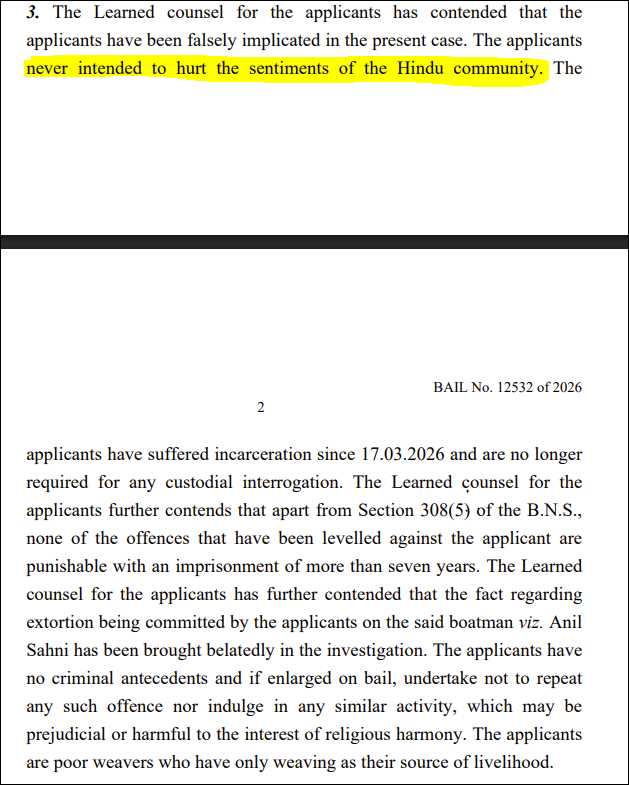
Appearing for the accused Muslim youth, advocate Raghuvansh Mishra claimed that his clients have been “falsely implicated” and that they “never intended to hurt the sentiments of the Hindu community.”
It was further contended that the accused persons have been incarcerated and are no longer required for custodial interrogation.
Moreover, advocate Mishra argued that other than Section 308(5) of the B.N.S., none of the offences that have been levelled against the applicant are punishable with an imprisonment of more than seven years. It was also argued that the Additional Advocate General, Anoop Trivedi, brought up the Muslim accused extorted money from boatman Anil Sahni angle belatedly in the probe.
“The applicants have no criminal antecedents and if enlarged on bail, undertake not to repeat any such offence nor indulge in any similar activity, which may be prejudicial or harmful to the interest of religious harmony. The applicants are poor weavers who have only weaving as their source of livelihood,” the advocate representing the accused persons said.
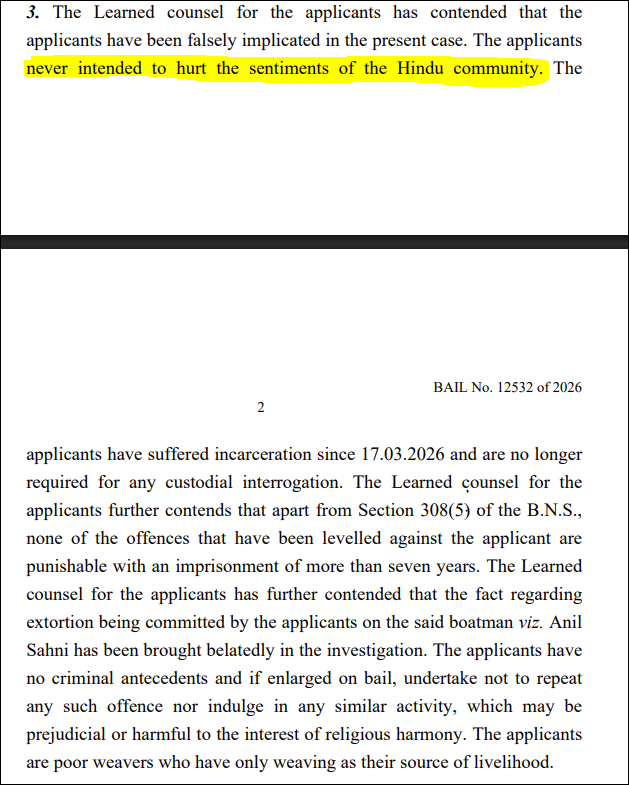
Meanwhile, Advocate General Anoop Trivedi, appearing for the State, strongly opposed the bail plea and argued that the Muslim accused have “not only desecrated the River Ganges but has also in a brazen attempt to disturb communal harmony, uploaded the video on Instagram through the handle of one of the accused viz. Mohd. Tahseem.”
Trivedi argued that the circulation of the video on social media was a deliberate act, a part of a larger conspiracy. “The video is part of a larger conspiracy to disturb public harmony, and an investigation is presently ensuing to find out who funded this Iftar party and was instrumental in promoting the uploading of the video,” he said.
Advocate Trivedi also emphasised the Hindu religious but also the national life-giving significance of the Ganga River. Trivedi submitted, “The Ganges being desecrated by the group of people, which has been identified to be the applicants and other accused, has hurt the sentiments of the country at large and not only the Hindu community and has also created a serious situation of public order.”
The Allahabad High Court observations after hearing the bail plea of the Muslim accused,who threw remains of non-veg food in the Ganga River
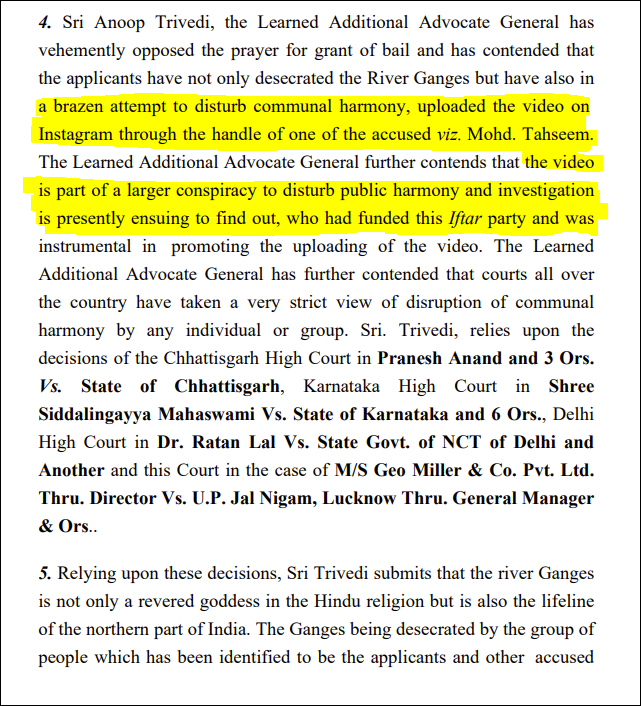
After taking note of the arguments presented by both sides, the Court said that it will not address the larger issue of the religious and national significance of the Ganga River. However, the court agreed “wholeheartedly” with advocate Trivedi’s points about the importance of the holy river and that the act as committed by the Muslim accused may disrupt communal harmony and snowball into a larger incident.
“…This Court wholeheartedly agrees with the submissions made by the Learned Additional Advocate General regarding the significance of the river Ganges not only to the Hindu community but also to the country at large. Disruption of religious harmony by the acts of a few may lead to a larger incident, and the concern expressed by the Learned Additional Advocate General, by relying upon the decisions of different High Courts, is also, to my mind, not unfounded,” the court observed, adding that social media has also emerged as a major hub of disinformation.
Addressing the issue of Muslim youth doing Iftar party on a boat on the holy Ganga River and throwing bones, Justice Rajiv Lochan Shukla said that such an act is hurtful to the sentiments of the Hindu community.
“The present case involves members of the Muslim community having a Roza Iftar party, and during the said Iftar party, while partaking of food, non-vegetarian food is said to have been consumed by the members of the Muslim community, who are then alleged to have thrown the remains into the River Ganges. This fact in the dispassionate opinion of the Court could rightly be said to hurt religious sentiments of the Hindu community,” the court said.
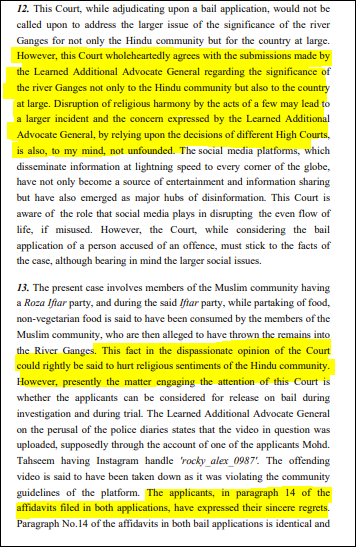
The court further stated that the video of accused Muslim youth throwing non-veg food leftovers in the Ganga River was uploaded on Instagram by one of the accused, Mohammed Tahseem, was taken down for violating the social media platform’s community guidelines. The court also noted that the accused persons have expressed regret over their act in their affidavits.
“That the perusal of the first information report affirm and reaffirm that no offence is constituted under the alleged sections but without admitting the applicants and their family most sincerely regrets and feels pain of what has been alleged against them in view of the society at large,” the affidavits filed by the petitioners read.
In view of the apparent remorse expressed by the incarcerated Muslim men, the court opined that the regret expressed in the affidavits filed by the counsels of the accused on their behalf does not come across as an attempt to simply escape the punishment of the law.
The court highlighted that the incarcerated Muslim men have been booked under sections 298, 299, 196(1)(b), 270, 279, 223(b) & 24 B.N.S. and Section 24 of the Water (Prevention and Control of Pollution) Act, 1974, none of which carry punishment for more than seven years.
Justice Shukla also sees the story of boatman Anil Sahni through a lens of suspicion since the allegations of the accused persons threatening him Sahni were added later.
Pertinently, however, the court stated that the investigation into the Iftar party, the offensive video and the alleged conspiracy to stoke communal tensions can continue.
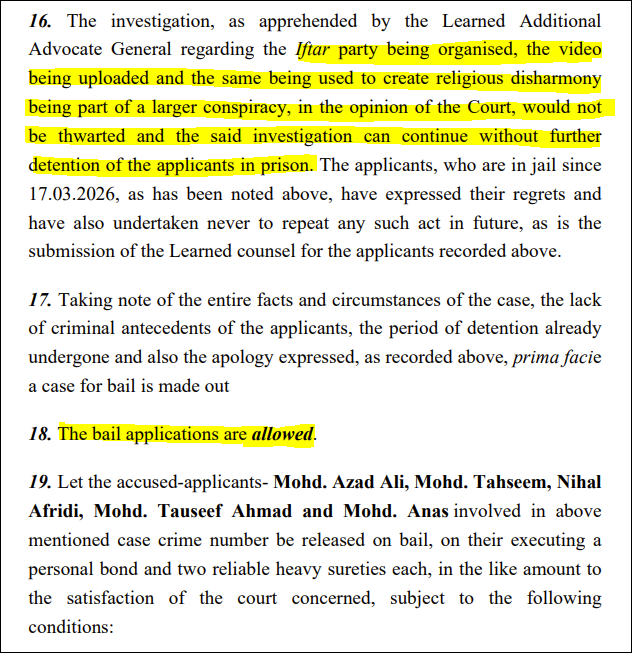
“The investigation, as apprehended by the Learned Additional Advocate General regarding the Iftar party being organised, the video being uploaded and the same being used to create religious disharmony being part of a larger conspiracy, in the opinion of the Court, would not be thwarted and the said investigation can continue without further detention of the applicants in prison. The applicants, who are in jail since 17.03.2026, as has been noted above, have expressed their regrets and have also undertaken never to repeat any such act in future, as is the submission of the Learned counsel for the applicants recorded above,” the court said, noting that five of the accused persons don’t have any criminal antecedents.
“Taking note of the entire facts and circumstances of the case, the lack of criminal antecedents of the applicants, the period of detention already undergone and also the apology expressed, as recorded above, prima facie a case for bail is made out. The bail applications are allowed,” the court ruled.
The court also made it clear that the observations made in this matter are “exclusively for deciding the instant bail application and are not to be considered to be an opinion on the merits of the case.”
In a separate order passed on 15th May, Justice Jitendra Kumar granted bail to other accused persons, Mohammad Sameer, Mohammad Ahmad Raza and Mohammad Faizan. The decision came in the wake of the accused Muslim youths assuring not to repeat such anti-Hindu acts in the future.
“The applicants have been languishing in jail since 17.03.2026 and they have undertaken to file affidavit before the learned Court concerned and the concerned police station that they will not indulge in/repeat similar activities in future,” the court said, adding that the accused will furnish a bond of Rs 50,000 each along with two sureties under bail bond procedure.
Ganga sacrilege and Muslim victimhood
On 17th March, 14 Muslim youths were arrested for throwing leftover chicken biryani into the Ganga in Varanasi after their Iftar party, not very far from the Bindu Madhav Temple. The arrest came after outrage erupted on social media over the video of the incident uploaded on Instagram by one of the accused, Mohammed Tahseem. As Hindus outraged on social media, a case was soon registered based on the complaint lodged by the Bharatiya Janata Yuva Morcha (BJYM) Varanasi president, Rajat Jaiswal.
On 16th March, a Muslim youth arranged a Roza Iftar party and invited people. Dry fruits and chicken biryani were served during the party. The video shows people eating together from a vessel.
Rajat Jaiswal stated in his complaint that people ate chicken biryani and threw the bones into the sacred Ganga River, hurting religious sentiments. He further said that this has hurt the sentiments of Sanatanis and that young people in the Muslim community are deliberately promoting a jihadist mindset.
After the controversy, Varanasi boat operators formulated new rules, and the BJP government in Uttar Pradesh announced that it would launch a dedicated online portal for boat operators.
A repetitive but interesting aspect of this entire episode was the Muslim victimhood propaganda peddled by the usual suspects in media, in politics and on social media. Congress leaders like Supriya Shrinate were quick to defend the Muslim youths who threw chewed bones in the Ganga River.
Islamist commentators, notorious for peddling fake news to further the Muslim victimhood bogey, also attempted to whitewash the anti-Hindu act of the accused persons. Some even went to the extent of invalidating the Hindu community’s outrage over Muslim throwing bones in the Ganga, claiming that even Hindus immerse the ashes of their deceased in the sacred river.
They shamelessly equated the throwing of chewed bones by Muslim men in the river Hindus worship as mother, with the act of immersing ashes of the deceased Hindus.
Islamist Wasim Akram Tyagi had posted on X, “What is a crime? Eating chicken biryani in a boat or throwing a bone into the Ganga? Now the question is, how is this a crime? If this is a crime, then ashes are immersed in the very same Ganga! So isn’t that also a crime? Along the banks of this very Ganga, there are cremation grounds everywhere, half-burnt bodies are floated away in it— so isn’t that also a crime? In this very Ganga, who knows how many such creatures live that are carnivorous— so isn’t their very existence in the Ganga a crime? Will the government remove all those creatures from the Ganga?”
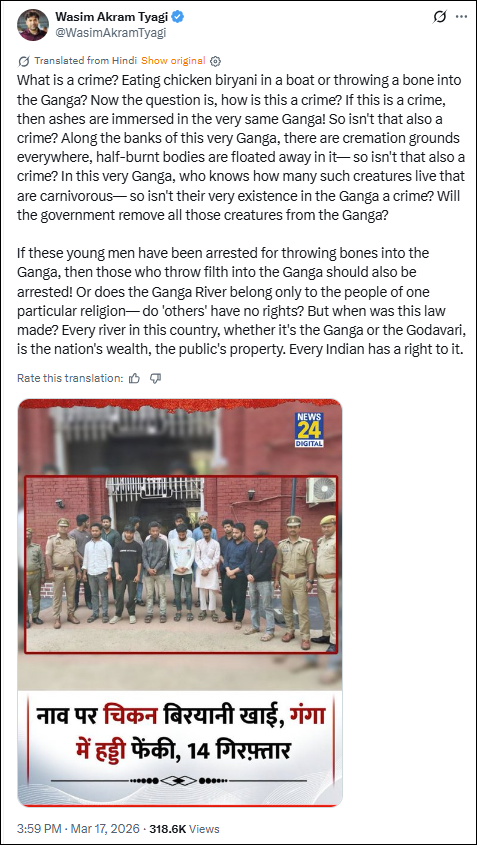
Wasim Tyagi and many other such Islamists deliberately downplayed the significance of immersing ashes of the deceased in the Ganga River to justify the sacrilege committed by the accused. As described in the Garuda Purana, immersing the remains after cremation is believed to help the departed soul attain moksha, heaven, or Brahmaloka. Since the Ganga is considered to have descended from the heavens, it is believed to liberate ancestral souls and break the cycle of rebirth.
Many even argued that the Ganga is not a Hindu-exclusive river and that Muslims too are equally allowed to use its waters, take a boat ride, have an Iftar party and throw non-veg food leftovers in the river, since their religion does not consider the Ganga River as sacred. However, if by the same logic, a Hindu or any non-Muslim goes inside a mosque and consumes pork there, especially during Ramzan, will that be acceptable since, unlike Muslims, pork is not considered haram by Kafirs?
OpIndia had reported earlier about leftist rag The Wire platforming a Delhi-based writer, translator and researcher, Rakhshanda Jalil, to secularise the Ganga River, in pursuit of whitewashing the sacrilege of the holy river by the Muslim youths. The article claimed that the Ganga River belongs to all faiths since many Muslim poets wrote couplets in the praise of the river’s scenic beauty. However, not one piece of poetry the article cited revered Ganga as Mother or Devi, the divine, as Hindus do.
Now, when the Allahabad High Court has said that throwing bones and other non-veg food leftovers in the sacred Ganga River can hurt Hindu religious sentiments, the same Islamo-leftist cabal is selectively highlighting only the Muslim accused getting bail part.