
There was a time when ‘premium’ in India’s electronics market was a ceiling most consumers would not consider breaching. That ceiling has been lifting. There has been a clear premiumisation trend, with consumers becoming more willing to invest in higher-value devices when they see meaningful differentiation. In the laptop segment, it is not just cracking, it is being rebuilt from scratch, with a new kind of buyer on the other side of the counter: one who knows what an NPU is, has compared refresh rates on two browser tabs, and is still not convinced.
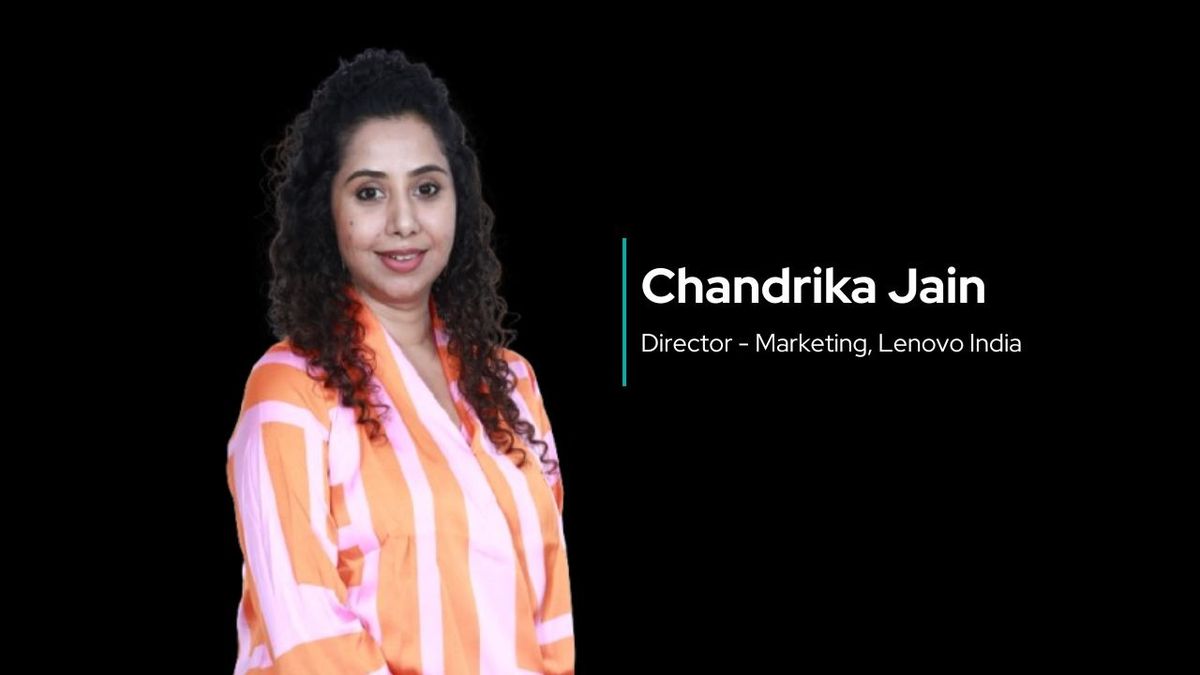
This is the market Chandrika Jain, Director of Marketing at Lenovo India, operates in. And according to her, the shift is less about aspiration and more about information.
India’s laptop market has been on an interesting trajectory. The pandemic years of 2020 and 2021 created an artificial surge in demand, followed by a contraction of 14% in 2022 and 8% in 2023, according to NIQ/GfK data. The market began to stabilise again through 2024, partly on the back of a new wave of AI-enabled devices entering the channel. According to Gartner, global shipments of AI PCs was projected to reach 114 million units in 2025, a 165% increase from 2024, with AI laptops expected to account for 51% of total laptop shipments that year.
That is a significant number. But back in India, the consumer reading those headlines may still not be sure what an AI PC actually does for them.
Jain is candid about what is driving buyers today. “Value today does not necessarily mean lower cost. For many consumers, it means better performance, stronger specifications, improved screens, sharper resolution, and a more capable overall experience. Devices that offer that level of differentiation are seeing stronger interest, and AI PCs naturally fit into that consideration set,” she says.
What she describes is a buyer who has done the research before making the decision. Indian consumers, she notes, are comparing specifications carefully and are clear about what they are paying for before they ever walk into a store or open a product page. “More than just buying into the AI label, they are buying into the tangible value and performance the technology delivers,” she adds.
This intentional buying behaviour is also reflected in Lenovo’s own commercial performance. In the third quarter of FY26, the company reported a 7% year-on-year revenue increase to INR 8,145 crore, with demand for advanced computing solutions, servers, and data infrastructure cited as contributing factors.
Human-first lens central to marketing AI
The growing appetite for premium devices, however, runs headlong into a persistent knowledge gap. Globally, a survey found that only 22% of consumers were aware of AI-enabled PCs, and fewer than one in five considered AI an important factor in their next laptop purchase. Awareness barriers, not price, topped the list of purchase obstacles: 43% of respondents were unfamiliar with AI PC benefits, compared to 33% who cited high prices as a concern. While the study focused on Germany, the pattern maps onto other markets where consumer education around device-level AI is still in its early stages.
Lenovo’s own research pointed to the same problem. Jain says, “AI is a powerful shift, but it is still widely misunderstood. In our consumer research, we found that many people still associate AI only with platforms like ChatGPT or the cloud, without fully understanding what AI can do beyond that.” She explains, “That reinforced something important for us: as marketers, our job is to simplify AI and make it easier to understand.”
That is a communication problem before it is a product problem, and it has shaped how Lenovo has approached its marketing entirely. Rather than leading with architecture specs or NPU benchmarks, the brand’s strategy has been to put the person, whether that is a creator, gamer, analyst, or student, at the centre, and show AI as something that serves them rather than defines the product.
“We focus less on technical jargon and more on practical use cases, showing how AI can improve productivity, creativity, and convenience in everyday life. We position AI not just as a feature, but as a collaborator, something that works alongside you to amplify what you do,” says Jain. “The human-first lens is central to how we market AI.”
That principle shows up clearly in the campaigns Lenovo has run recently. For example, Made with Lenovo Yoga (Aura Edition), a creator-led initiative that paired traditional Indian artisans with contemporary digital creators across Odisha, Rajasthan, and Kashmir. The campaign produced three cinematic short films covering Pattachitra, Kaavad, and Kashmiri carpet art, each exploring how AI-assisted tools on Lenovo’s Yoga Aura Edition devices can help document and adapt centuries-old art forms for modern audiences. The films were distributed via Hotstar and targeted Gen Z viewers who, research showed, value Indian cultural heritage but have limited direct exposure to traditional art forms.
Jain described the thinking behind the campaign. “India’s artistic heritage carries centuries of skill and storytelling, and we see AI as a powerful tool to help it thrive in the future. Our goal is to show how technology can be used for good, not to replace tradition, but to preserve it, share it. By giving creators AI-powered capabilities that respect the authenticity of handcrafted art, we enable them to push creative boundaries and reimagine cultural narratives in formats that resonate with today’s young audiences.”
Rather than making the device the protagonist, the campaign positioned AI as the medium through which tradition could survive and travel into new formats. The mediums chosen, digital video and connected TV, reflected a full-funnel approach. Lenovo’s media strategy has evolved to follow attention as it shifts across platforms, with high-impact video formats prioritised for brand building and audience-specific targeting layered in for relevance.
At Lollapalooza India 2025, the brand extended this thinking into physical space. In collaboration with Intel India and dentsu Sports & Entertainment India, Lenovo set up the Creators’ House Party, a living-room-style installation where festivalgoers could turn their doodles, clicks, and musical inputs into a shared digital canvas. The activation reached over 10 million people and recorded more than 8,000 on-ground participants during the live period.
On why a music festival made sense for a technology brand, Jain points out, “For Gen Z and young creators, live music is cultural currency. At Lenovo, we aim to be meaningfully present in moments where culture and self-expression come together. Our presence at Lollapalooza India, through the Creators’ House Party, focused on enabling creativity, encouraging play, experimentation, and co-creation, bringing Lenovo Yoga’s AI-powered innovation into a space that resonates deeply with this generation.”
The impact, Jain notes, tends to show up over time through long-term brand metrics like awareness, consideration, and preference, along with improvements in brand imagery scores and channel partner feedback. The events are part of a broader cultural presence strategy that also includes Comic-Con, built on research into where younger audiences spend attention.
For the Pixel Deficiency campaign, launched in March 2026, the approach was sharper and more targeted. Rather than a broad cultural play, this was a product-specific campaign for Lenovo’s monitor range built around a single consumer insight: poor display quality actively gets in the way of how people work, game, and study. The campaign introduced a fictional ‘Pixel Deficiency’ condition, depicting an analyst misreading a spreadsheet number, a designer unable to distinguish between colour shades, a gamer misidentifying an opponent, and a student struggling with a blurred lecture slide. Each scenario pointed to the monitor, not the user.
Jain explained how the research shaped the campaign’s direction: “Through research, we found that monitor quality was a key concern for consumers, particularly around clarity and visual performance. Work-from-home behaviour emerged as a strong use case, so the messaging was tailored around how monitor quality mattered to four specific audiences: small business owners, analysts, gamers, and students.” The digital-first campaign ran from mid-March to mid-April 2026 with influencer support layered in, targeting each cohort with contextual messaging built specifically for them.
Where Made with Lenovo Yoga was cultural and experience-led, Pixel Deficiency was narrower, more product-led, and built for targeted relevance.
Commerce is moving, and so is Lenovo’s strategy
Beyond creative strategy, Lenovo’s go-to-market picture is being shaped by structural changes in how consumers actually buy. E-commerce has grown substantially as a channel for electronics in India, and quick commerce, driven by urban consumers’ expectation of fast, convenient delivery, is becoming a meaningful part of that mix.
For categories like accessories and peripherals, where purchase decisions are more immediate, the shift toward online has been particularly strong. Lenovo is scaling investment in quick commerce alongside broader e-commerce growth, treating it as a complementary channel rather than a standalone one.
Looking further ahead, Jain sees the marketing conversation shifting from AI as a differentiator to AI as a baseline expectation. As the technology becomes standard across most laptop SKUs, the work of brands will be to show its real-world impact rather than simply announce its presence. “The focus is on making AI feel useful. We do not lead with AI as a feature; we position it as an enabler and explain what it can actually do for people in practical, everyday terms,” she says. “Instead of simply saying this is an AI PC, the more important question is: what does an AI PC help you do better? When communication is built around that answer, AI feels less overwhelming and more relevant.”
Consumers who are already reading spec sheets and comparing NPU capabilities are ahead of most marketing. The job now is to bring the rest of the market to the same level of understanding, and to do it through stories that are useful, specific, and honest about what the technology actually delivers.