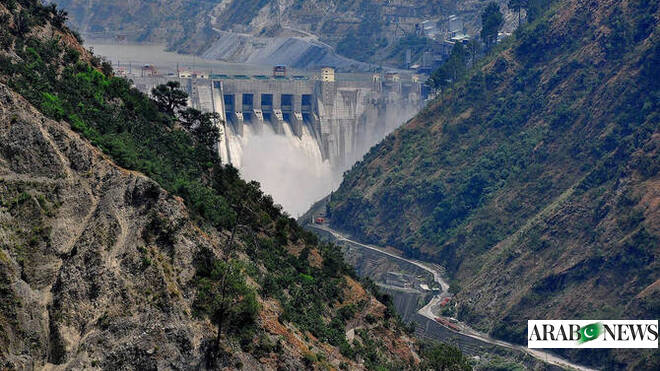
ISLAMABAD: Pakistan on Sunday voiced satisfaction over the Permanent Court of Arbitration’s (PCA) recent supplemental award concerning maximum pondage in the Indus Waters Treaty (IWT) proceedings concerning India’s Ratle and Kishenganga hydroelectric projects, saying it reaffirmed limits “substantive” limits on India’s water-control capability on the Western Rivers.
The IWT, mediated by the World Bank, grants Pakistan rights to the Indus basin’s western rivers — Indus, Jhelum, and Chenab — for irrigation, drinking, and non-consumptive uses like hydropower, while India controls the eastern rivers — Ravi, Beas, and Sutlej — for unrestricted use but must not significantly alter their flow. India can use the western rivers for limited purposes such as power generation and irrigation, without storing or diverting large volumes, according to the agreement.
The archfoes have tried to settle some of their differences at the PCA in the Hague. These concerns related to the size of the water storage area at the Kishenganga and Ratle hydroelectric plants. In August, the PCA rendered an award on issues of general interpretation of the IWT, explaining the designed criteria for the new run-of-river hydropower projects. Islamabad said the court declared that India shall “let flow” the waters of the western rivers for Pakistan’s unrestricted use.
In a statement issued on X Sunday night, the Pakistani government said the PCA on May 15 handed down a supplemental award concerning maximum pondage in the IWT proceedings relating to disputes over Ratle and Kishenganga project designs, which affirmed “Pakistan’s central position that the Treaty places substantive limits on India’s water-control capability on the Western Rivers.”
“These limits are not formalities. They apply at the planning and design stage and cannot be satisfied merely by a later assurance of operational restraint,” the Pakistani government said in its statement.
“Pondage for a Run-of-River Plant must be justified by real project needs, actual expected operation, site hydrology, hydraulic conditions, power-system requirements, and the information and explanation required under the Treaty.”
Pakistan’s foreign office said in August the specified exceptions for hydro-electric plants must conform strictly to the requirements laid down in the Treaty, rather than to what India might consider an “ideal” or “best practices approach.”
Building on the Court’s award of August 8, the supplemental award gave practical effect to the standard that “installed capacity and anticipated load must be realistic, well-founded and defensible,” according to Islamabad
“Installed capacity must correspond to actual expected operation, hydrologic and hydraulic data, and Treaty requirements. Anticipated load must correspond to actual expected operation and to the projected needs of the power system the plant is intended to serve. This addresses a core Treaty concern,” the Pakistani government said on Sunday.
“India cannot justify increased Pondage through imagined capacity, artificial load curves, unrealistic peaking assumptions, or bare assertions of compliance” with release limits.
It said the May 15 supplemental award strengthened Islamabad’s review rights.
“India must provide Pakistan with sufficient information and explanation to assess Treaty compliance,” the government in Islamabad said.
“The Court further confirmed that any applicable minimum-flow obligation must be taken into account in calculating Pondage required for Firm Power where such obligation exists and is not otherwise satisfied.”
There was no immediate comment from India on the subject, while New Delhi announced in April 2025 that it was suspending the IWT, following an attack in Indian-administered Kashmir that India had blamed on Pakistan.
Pakistan said on Sunday it was committed to the Indus Waters Treaty, its dispute-resolution procedures, and the peaceful settlement of water-related differences.
“Pakistan will continue to protect its rights under the IWT and will pursue every lawful and diplomatic means to ensure that hydroelectric projects on the Western Rivers are designed and operated strictly within Treaty limits,” the government in Islamabad said.
“The Award is a strategic consolidation of Pakistan’s Treaty position: maximum Pondage must be realistic, evidence-based, hydrologically grounded, power-system justified, Treaty-compliant, and incapable of inflation through artificial assumptions.”