
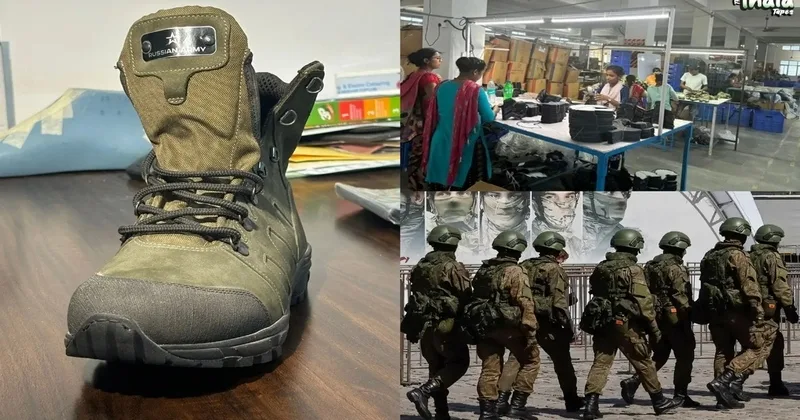
India’s rise as a defence manufacturing power has long been symbolised by high-profile systems like the BrahMos missile and the HAL Tejas. These platforms represent technological sophistication and strategic capability. Yet, beyond the spotlight of missiles and fighter jets, a quieter but equally significant transformation is taking shape—one that begins in an industrial facility in Hajipur, Bihar.
🚨From Missiles to Combat Boots: How Bihar Became Part of Russia’s Military Supply Chain
For years, the world associated India’s defence rise with systems like the BrahMos missile, the HAL Tejas fighter jet, and indigenous warships. But a quieter transformation is now unfolding… pic.twitter.com/uMmn4bZMiw
— Not Just Headlines (@Notjustheadline) May 13, 2026
The Unexpected Origin of a Global Defence Link
In Hajipur, a factory operated by Competence Exports has emerged as an unlikely yet critical node in the global military supply chain. What sets this facility apart is not just its scale, but its clientele: Russian military forces. What once might have seemed improbable, a factory in Bihar producing combat boots for one of the world’s largest armies is now a reality. This development signals a broader shift in India’s defence exports, moving beyond conventional weapons to include essential battlefield gear.
From Local Manufacturing to Global Demand
The journey began in 2018, when Competence Exports established its manufacturing base in Hajipur. Initially under the radar, the company steadily built expertise in tactical military footwear—a niche segment demanding high precision and performance standards.
By 2023, the scale of operations had expanded dramatically. The company reportedly exported nearly 15 lakh pairs of combat boots, valued at around Rs 100 crore. This rapid growth reflects not just rising demand but also increasing global confidence in Indian manufacturing capabilities.
Built for the Battlefield
The appeal of these boots lies in their performance under extreme conditions. Designed for harsh combat environments, they feature:
-Lightweight construction for mobility
-Slip-resistant soles for stability across terrains
-Advanced insulation capable of withstanding temperatures as low as –40°C
Such features make them suitable for deployment in snow-bound regions, muddy battlefields, and high-intensity operational zones—conditions commonly faced by Russian troops.
India’s Industrial Advantage
India’s emergence in this segment is no accident. It is backed by a strong ecosystem that includes:
-A well-established leather industry
-Skilled and cost-effective labour
-Modern manufacturing technologies
-High adaptability to custom requirements
-Large-scale production capabilities
Traditional manufacturing hubs like Kanpur and Agra, along with emerging centres like Hajipur, are now playing a pivotal role in supplying specialised footwear to global markets.
Beyond Defence: A Global Footprint
The Hajipur facility is not limited to military contracts. It is also producing high-end designer footwear for European markets, exporting to countries such as Italy, France, Spain, and the United Kingdom. This dual capability, serving both defence and fashion sectors—highlights the versatility and quality of Indian manufacturing.
Redefining “Made in India”
This evolution marks a deeper transformation in how “Made in India” is perceived globally. No longer confined to being a low-cost alternative, Indian products are increasingly recognised for their reliability, durability, and quality.
Bihar’s entry into the global defence supply chain is particularly noteworthy. Traditionally not seen as an industrial powerhouse, the state is now contributing to a sector of strategic importance. It underscores how decentralised industrial growth can reshape national economic narratives.
India’s defence story is no longer just about missiles and fighter jets. It is also about the boots on the ground—literally. The rise of a Hajipur-based factory supplying combat boots to Russian soldiers illustrates a broader shift in global manufacturing dynamics.
In the evolving landscape of defence production, even the most fundamental equipment can carry strategic significance. And in this new reality, Bihar has found its place, not on the margins, but firmly within the global supply chain.