Dr. Gupta chaired a MOHFW-constituted working group (2019) tasked with building convergence between Ayushman Bharat and Health and Wellness Centres.
The Ayushman Bharat Paradox: Why Indians Still Shun Public Healthcare
It is deeply paradoxical that despite India’s extensive population-based public health network designed to serve every household through a tiered architecture spanning primary, secondary, tertiary, and super-specialty care, its utilisation remains strikingly low.
According to the NSS 80th Round (January–December 2025) conducted by the Ministry of Statistics and Programme Implementation, only about 25% of the urban population and 35% of the rural population depend on public health facilities for the treatment of non-hospitalisation ailments. This limited utilisation is alarming, particularly in a country where a large proportion of the population lacks the financial capacity to afford private medical care. As highlighted by the CEO of a leading medical insurance aggregator, Policy Bazaar, merely 30–35% of India’s population can afford private health insurance, and even within this segment, coverage is often partial and inadequate.
Also Read:Neglected Public Healthcare Centres in Gautam Buddh Nagar In Uttar Pradesh Exposed
Advertisment
The Financial Reality: Why Public Healthcare Fails
Data from the NSS 80th Round further illuminate the financial consequences of this imbalance. The average out-of-pocket expenditure per outpatient visit stands at ₹861 in private facilities, compared to ₹281 in publi
Dr. Gupta chaired a MOHFW-constituted working group (2019) tasked with building convergence between Ayushman Bharat and Health and Wellness Centres.
The Ayushman Bharat Paradox: Why Indians Still Shun Public Healthcare
It is deeply paradoxical that despite India’s extensive population-based public health network designed to serve every household through a tiered architecture spanning primary, secondary, tertiary, and super-specialty care, its utilisation remains strikingly low.
According to the NSS 80th Round (January–December 2025) conducted by the Ministry of Statistics and Programme Implementation, only about 25% of the urban population and 35% of the rural population depend on public health facilities for the treatment of non-hospitalisation ailments. This limited utilisation is alarming, particularly in a country where a large proportion of the population lacks the financial capacity to afford private medical care. As highlighted by the CEO of a leading medical insurance aggregator, Policy Bazaar, merely 30–35% of India’s population can afford private health insurance, and even within this segment, coverage is often partial and inadequate.
Also Read: Neglected Public Healthcare Centres in Gautam Buddh Nagar In Uttar Pradesh Exposed
Advertisment
The Financial Reality: Why Public Healthcare Fails
Data from the NSS 80th Round further illuminate the financial consequences of this imbalance. The average out-of-pocket expenditure per outpatient visit stands at ₹861 in private facilities, compared to ₹281 in public institutions for a treated spell of ailment, where the median expenditure is effectively zero. Notably, nearly half of patients using public facilities incur no direct costs, whereas in private settings, half spend more than ₹400 per episode.
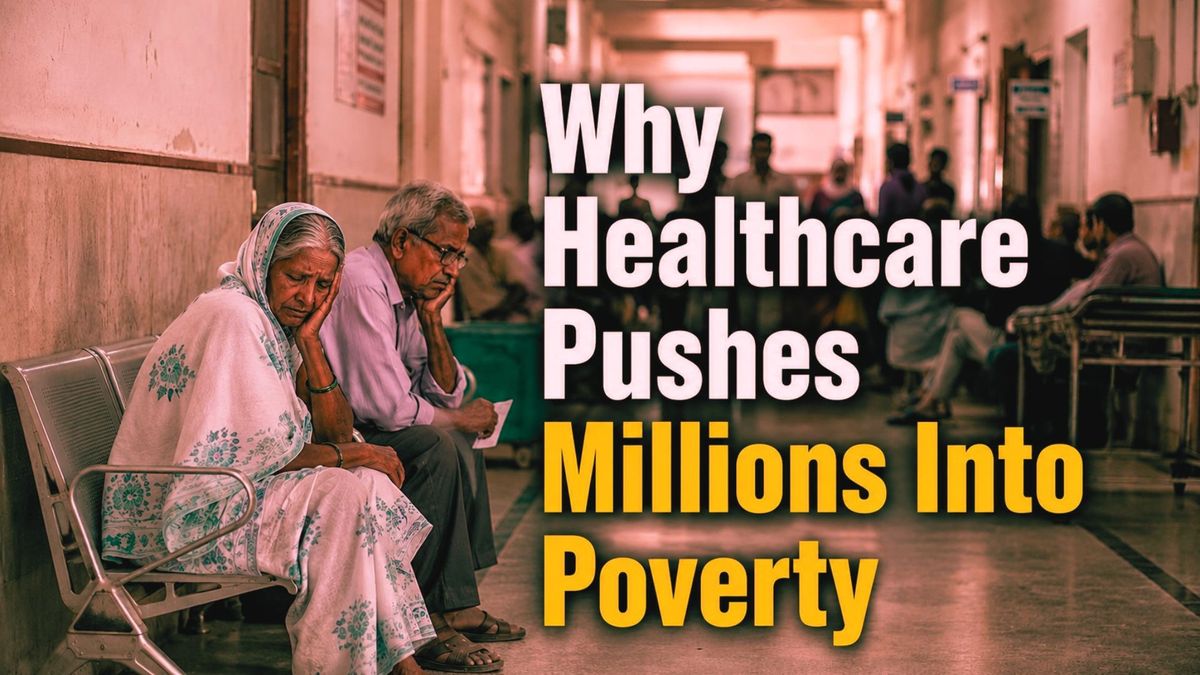
In hospitalised cases, out-of-pocket expenditure skyrockets to ₹6,631 in public hospitals and ₹50,508 per hospitalisation case. Given the high frequency of outpatient episodes, a family spends far more out of pocket in OPD care, as this is neither covered in social insurance schemes like Ayushman Bharat (PMJAY) nor in privately purchased plans by families. The disparity between expenditure in public and private settings substantially increases the financial burden on households, often pushing families into poverty or trapping them in cycles of prolonged economic vulnerability. Earlier estimates from the NSS 78th Round (2017) suggested that nearly 55 million Indians are pushed into poverty annually due to catastrophic health expenditures—a troubling pattern that shows little evidence of reversal in the latest data.
India’s public health system, widely regarded as the backbone of healthcare delivery for economically vulnerable populations, continues to grapple with persistent challenges related to accessibility, quality, and efficiency. Bridging the gap between system design and actual utilisation is therefore critical. While health remains a state subject, resulting in considerable variations across states and geographies, the aggregate national picture reveals significant systemic gaps. These gaps contribute to sustained high morbidity and premature mortality. On one axis, the country continues to struggle with infectious diseases; on another, it faces a rapidly growing burden of non-communicable diseases, creating a dual challenge that strains the system further.
Also Read: Ayushman Bharat: Grand Promises, Harsh Reality on the Ground
The System Design Versus Ground Reality
Structurally, the system is well-conceived. Sub-Health Centres (now Ayushman Arogya Mandirs) cater to populations of 3,000–5,000; Primary Health Centres (PHCs) serve 20,000–30,000; and Community Health Centres (CHCs) cover approximately 80,000 people. These are supported by Sub-District Hospitals, District Hospitals, and Medical College Hospitals, each with clearly defined roles and responsibilities. In principle, patients with minor ailments should first access primary-level facilities and move upward only, when necessary, through a structured referral system.
In practice, however, this hierarchy is routinely bypassed. Patients frequently seek care directly at higher-level institutions even for common conditions such as fever, cough, or body pain, leading to overcrowding, compromised quality of care, and delays for critically ill patients. Simultaneously, primary health facilities remain underutilised due to limited operating hours, workforce shortages, inconsistent drug availability, and non-functional equipment.
Further complicating the landscape, NSS data indicate that 65% of rural and 75% of urban patients who seek private care rely significantly on informal providers, many of whom operate in villages and urban slums. These individuals, lacking formal medical training, range from faith healers and indigenous practitioners to those administering intravenous fluids, antibiotics, and corticosteroids for routine ailments. Such practices not only impose unnecessary financial burdens on patients but also pose serious risks to safety, including misdiagnosis, antimicrobial resistance, and avoidable complications.
Strengthening Ayushman Bharat Through Systemic Reform
Addressing both the overreliance on informal providers and the overcrowding of higher-level public institutions requires a fundamental rationalisation of public health service utilisation, beginning with robust strengthening of primary healthcare. Assigning a designated primary care facility to every family can establish a clear and accountable first point of contact. Patients with non-serious conditions should be systematically encouraged, if not institutionally guided, to seek care at this level, with well-defined referral pathways governing access to higher tiers. Additionally, simple digital tools and mobile applications can help individuals identify nearby primary care facilities during travel, much like widely used platforms for locating fuel stations or restaurants. Such a gatekeeping mechanism would streamline patient flow, optimise resource allocation, and allow higher-level institutions to focus on complex and critical cases.
Reducing out-of-pocket expenditure must remain a central policy objective. High medical costs continue to drive financial distress across India, largely due to gaps in accessible, reliable, and trusted public healthcare. Schemes like Ayushman Bharat and PMJAY were designed to address this, yet more than half of out-of-pocket expenditure in outpatient care stems from medicines, which can be significantly reduced through stronger primary care infrastructure. Strengthening primary care and rationalising service delivery can bring affordable, quality healthcare closer to people’s homes, significantly reducing financial hardship even within existing resource constraints. Preventive and promotive health services delivered at the primary level can further reduce disease burden and long-term costs.
Decentralisation of health system governance represents another crucial pillar of reform. Empowering local governments with statutory administrative and financial authority can enhance responsiveness, accountability, and efficiency. Local bodies are better positioned to understand community-specific health needs, cultural contexts, and behavioural patterns, enabling more targeted interventions and improved health outcomes. They are also strategically placed to discourage reliance on informal providers and curb the continuous drain of both economic and health resources from vulnerable populations.
Also Read: Medical Negligence Law in India: Why Doctors Escape Accountability
However, devolution of authority to manage the public health system must be carefully balanced with good coordination at central and state levels to ensure uniform standards of care and equity across regions. Higher levels of government must continue to provide policy direction, technical guidance, need-based capacity building, and assessment of outcomes. Sustained success will depend on adequate funding, continuous human resource development, technological integration, and robust accountability frameworks with grievance redress systems.
In conclusion, rationalising public health services is not merely an administrative adjustment—it is an ethical, social, and economic imperative. A more efficient, accessible, and equitable healthcare system can be realised by reinforcing primary care, operationalising a functional referral system, regulating informal practices, and empowering local governance within a cohesive national framework. The urgency is undeniable: the health, dignity, and financial security of millions depend on decisive, sustained, and systemic action today.