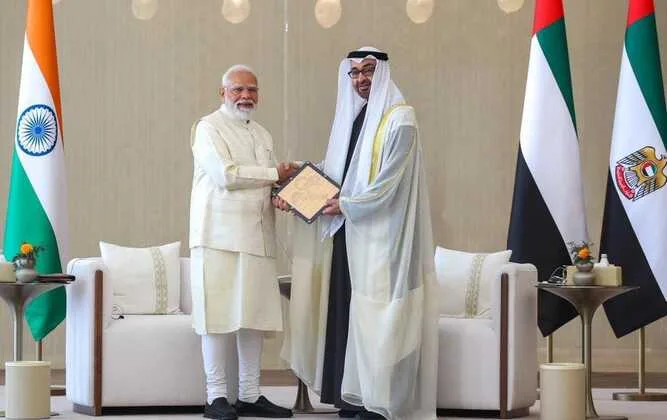
Abu Dhabi: As the world grappled with an energy crisis, geopolitical instability and fears of disruption to critical shipping routes in West Asia, Prime Minister Narendra Modi’s brief visit to the United Arab Emirates on May 15 delivered significant strategic and economic gains for India, with energy security emerging as the central pillar of the expanding partnership between the two countries.
The visit to Abu Dhabi came at a time when uncertainty in global crude markets and tensions in the region have raised concerns over supply chains and maritime trade routes, particularly the Strait of Hormuz, through which a major portion of the world’s oil trade passes. Against this backdrop, India and the UAE signed a series of agreements covering strategic petroleum reserves, liquefied petroleum gas supplies, defence cooperation, maritime infrastructure and investments worth billions of dollars.
Energy security takes centre stage
A major outcome of the visit was the signing of a Memorandum of Understanding on Strategic Petroleum Reserves, aimed at strengthening India’s energy security amid volatile global oil prices and possible supply disruptions linked to regional tensions. The agreement deepens an already existing partnership in the energy sector, under which Abu Dhabi National Oil Company (ADNOC) remains the only foreign entity storing crude oil in India’s underground strategic reserves. Officials said the agreement would help India secure reliable long-term energy supplies while also providing the UAE with a stable market for its growing crude production capacity. With India among the world’s largest energy consumers, the pact is expected to provide greater resilience against sudden global price shocks and supply interruptions.
The two countries also concluded an agreement on the supply of Liquefied Petroleum Gas (LPG), a move seen as crucial for India’s domestic energy stability. Signed between Indian Oil Corporation (IOCL) and ADNOC, the agreement secures long-term and prioritised LPG supplies from the UAE, which currently meets nearly 40 per cent of India’s domestic LPG requirements.
The deal assumes significance as India seeks to diversify and secure energy imports while protecting domestic consumers from fluctuations in international fuel prices. The agreements collectively underscored how energy cooperation remains the backbone of the India-UAE strategic relationship.
Highlights from a productive UAE visit, which will deepen our bilateral friendship… pic.twitter.com/e8D8Wuuz0j
— Narendra Modi (@narendramodi) May 15, 2026
Defence, infrastructure and investments
Beyond energy, the visit marked a significant expansion of bilateral ties into defence and infrastructure sectors. India and the UAE signed an Agreement on Framework for the Strategic Defence Partnership, aimed at moving cooperation beyond routine military engagements towards joint development and co-production of advanced defence technologies. The agreement also provides for deeper intelligence sharing and stronger counter-terrorism coordination between the two countries at a time of evolving regional security challenges.
In the maritime sector, the two sides signed a Memorandum of Understanding for the establishment of a Ship Repair Cluster at Vadinar in Gujarat. The project is expected to strengthen India’s maritime infrastructure ecosystem and support its ambitions to emerge as a regional hub for ship maintenance and repair services. The UAE also announced investments worth USD 5 billion targeting Indian infrastructure projects, expansion of credit capacity at RBL Bank and liquidity infusion into housing financier Sammaan Capital.
The agreements reflected the rapidly growing depth of India-UAE ties, which have expanded well beyond traditional trade and energy relations in recent years. Following the signing of the Comprehensive Economic Partnership Agreement, bilateral trade between the two countries crossed the USD 100 billion mark, with both sides now aiming to increase it to USD 200 billion in the coming years.