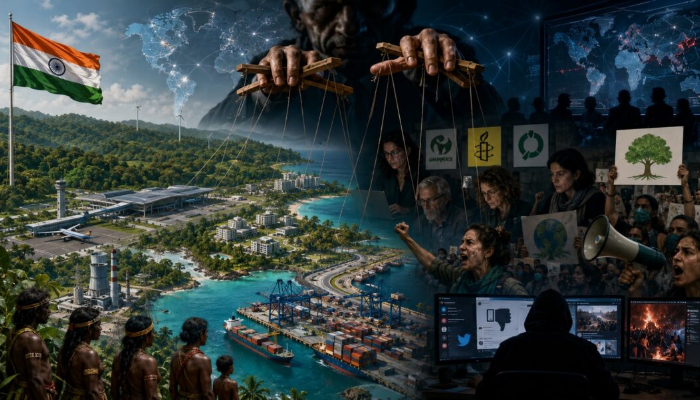
In the current age, conflicts are no longer exclusively conducted at borders with military tanks and weaponry. Instead, wars are now fought on mobile devices, featured on the front pages of global publications and within the offices of Non-Governmental Organisations (NGOs) that operate under the pretence of advocating for human rights. This phenomenon is referred to as “Hybrid Warfare” or “Asymmetric Warfare.” The main goal is to ensnare a rising power in domestic strife to the point where it cannot reach its full potential.
Whenever India embarks on a significant initiative, whether it be a nuclear facility, a major port or a mining project, why do “human rights outfits” and “environmental activists” from around the world suddenly spring into action?
One might presume that these individuals are simply safeguarding nature, a seemingly commendable pursuit. However, is this an authentic passion for the environment, or is there a meticulous geopolitical and ideological strategy at play aimed specifically at diminishing India’s growing influence?
Today, we will explore the intricacies of this very “Hybrid Warfare” where traditional weapons such as missiles and guns are replaced by narratives, information warfare, misinformation and fabricated news. We will examine the Great Nicobar Integrated Development Project (GNI), an initiative that 39 “genocide experts” from 13 nations endeavoured to stop in 2024 by writing an open letter.
We will also conduct a thorough analysis of the theory of Cultural Marxism, a concept that, via education, media and social platforms, is instilling the idea in the minds of the youth that “development” necessarily means “destruction.” More importantly, we will expose the foreign NGOs and international lobbies that are causing an annual blow of 2-3% to India’s GDP resulting in a loss of hundreds of thousands of crores of rupees, resources that could have been allocated to hospitals, educational institutions, infrastructure and energy security.
America’s “Trail of Tears” vs lecturing India
A country that was originally built on the appropriation of indigenous lands has now become the largest center for climate activism globally. Through the Indian Removal Act of 1830, the United States forcibly removed tens of thousands of Native Americans, commonly known as “Red Indians” from their ancestral lands. During the notorious Trail of Tears, between 60,000 and 100,000 persons, primarily from the Cherokee and other tribes were forcibly relocated. Many lost their lives during the journey, falling victim to starvation, illness and the dreadful conditions of the forced march.
The complete picture is even more disheartening. From the 15th to the 19th centuries, the Native American population experienced a significant decrease due to wars, diseases and the systematic removal of tribes. Nevertheless, this very nation has evolved into the birthplace of NGO culture, declared itself a superpower, and today, having risen as an alleged champion for climate change dictates the rest of the world. These entities that once forcibly occupied lands are now, via NGOs, teaching us how we should manage our own land.
The terminology that was created and popularised by America is currently being promoted by paid activists in different countries as a way to forge their own identities. Recent entries into this vocabulary include phrases like “heatwave,” “climate activism” and “tribes.” However, the core question persists: what is the source of this hypocrisy? And why is this exact narrative being repeated in India at this time?
Drawing insights from both America and Europe, a fresh type of activism is presently being propagated in India, disguised as advocacy for tribal rights and environmental issues. Terms such as “forest rights,” “tribal land” and “climate justice” serve as the framework for this activism. However, the underlying objective is the infiltration of Cultural Marxism, which is being facilitated through civil society organisations and NGOs.
On one side, efforts towards national development and nation-building are depicted as forms of oppression and exploitation and on the other hand, networks supported by foreign funding aim to alienate tribal communities from the national mainstream and use them against national security interests. This exemplifies a contemporary version of the “Divide and Rule” strategy, presently rebranded in the rhetoric of “sustainability” and “inclusion.”
These are the precise forces that are engaged in the breakdown of culture, tradition and sovereignty akin to how the West has turned its own missteps into a tale of moral superiority.
“Hybrid Warfare” and the secret report of 2014
Historically armed confrontations transpired along national borders, but we currently exist in a period defined by “Asymmetric Warfare” where the preferred tools are social media, NGOs and intellectual activism.
In 2014, the Intelligence Bureau (IB) presented a report to the Prime Minister’s Office, a document that profoundly impacted the nation. It clearly indicated that certain foreign entities were utilising various strategies to hinder India’s progress toward achieving a $5 trillion economy. These included amplifying local complaints and dissent while undermining investment by depicting the nation’s image on global platforms as anti-human or anti-environment.
In its report, the IB outlined the significant impact that these movements have had on India’s energy security and mining industry:
- Nuclear Energy (Kudankulam): Groups like “PMANE” and “Greenpeace” led protests that caused massive delays in enhancing India’s energy security.
- Coal and Mining (Mahan Coal Block): “ActionAid” and “Greenpeace” effectively prevented investment by creating a global narrative focused on carbon emissions.
- Industrial Hubs (POSCO and Vedanta): Billions of dollars in Foreign Direct Investment (FDI) were forfeited under the pretext of local activism.
- Agricultural Technology (Anti-GMO Protests): “ASHA” and “Greenpeace” obstructed agricultural productivity by hindering the adoption of innovative seed technologies.
Do you realise what the most concerning outcome of all this was? According to the IB, these actions led to a reduction of 2% to 3% in India’s yearly GDP growth rate. This equates to hundreds of thousands of crores of rupees, resources that could have been allocated to the development of hospitals, schools and infrastructure for our benefit.
Notably, these protests extend beyond the mere protection of trees or birds. In truth, climate activism has transformed into a multipolar ideological conflict of modern times. What we interpret as environmental concern is, in fact, “Watermelon Politics” appearing green on the surface, yet harbouring the same old red (Marxist) agenda inside.
Cold War strategy + Eco-Marxism + metabolic rift
As industrial development enhanced the conditions of workers, leftist ideology demanded a new instrument. They subsequently targeted the educated middle class and students, conducting a moral campaign against development initiatives. The objective is clear: To restrict the actions of elected governments through climate litigation and to challenge the nation’s sovereignty at the behest of foreign NGOs.
Interestingly, the foundations of this narrative are entrenched in the Cold War era. Since the 1960s, Western powers have adopted a strategy of creating emergencies and crises to maintain dominance over the populace. Currently, climate change is being depicted as a war-like emergency, with the purpose of suppressing the energy sectors and economies of developing nations.
This is the special reason these Western nations, particularly European countries such as Germany are currently resorting to “Regulatory Imperialism.” By imposing taxes like the CBAM (Carbon Border Adjustment Mechanism), they are inflating the costs of our steel and aluminum exports, which is resulting in India losing its foothold in the global market. This is similar to the Cold War strategy: Manufacture a crisis, spread fear and then masquerade as “experts” to dominate the world.
Heatwaves: A new narrative of fear
What, specifically, does the summer heat in our nation have to do with all of this? The true propaganda unfolds here: Whenever a heatwave hits India, the global media paints it as a disastrous crisis. Phrases like “95% of Indian cities at risk” and “wet-bulb temperatures” are frequently mentioned.
This data often amounts to scientific exaggeration and surfaces with remarkable timing, exactly when India initiates a new mining venture or power unit. The intention is to portray India as either a “victim” or a “villain,” thus creating international pressure with the underlying message: “Look, your country is burning. Therefore, stop the Nicobar project or any such initiative and invest in our costly green technologies instead.”
This signifies a well-coordinated effort to create skepticism about India’s economic stability and to characterise us as a weak nation. I do not deny the reality of the heat, instead, I oppose the fear-mongering tactics being used to threaten India’s energy security (specifically coal and gas), while the West itself continues to rely heavily on fossil fuels.
Furthermore, the Western entities that have mainly mushroomed in the current times and attempt to involve India in such ethical predicaments, perhaps fail to comprehend the fact that new India has no need for Western knowledge or assessments. For us, nature is not just a “resource,” it has perpetually been a crucial component of our existence.
The Atharvaveda includes the mantra: “Mata Bhumih Putroham Prithivyah.” This is interpreted as: “The Earth is our mother, and we are her children.” While Western societies aim to dominate nature, our tradition promotes coexistence and unity with it. We do not need Western-style “watermelon” activism. We require our own time-honored Dharmic Ecology, a belief system that values and reveres both progress and the natural world.
Civil Society and Cultural Marxism
Now, as inquiry arises: How do these persons achieve such organisation? How does their collective intellect operate? This is where Cultural Marxism makes its appearance.
When we examine history, in the early 20th century, thinkers from the “Frankfurt School” such as Max Horkheimer and Theodor Adorno observed that the working class was not rising up for revolution. Consequently, they revised their strategy. They asserted that the onslaught should be executed not through violence, but cultural influence.
This methodology is referred to as “Critical Theory,” which aims to depict institutions like family, religion and nationalism as “oppressors.” Today, this ideology has transformed into “Eco-Marxism.” Karl Marx introduced a theory called the “Metabolic Rift” This theory asserts that capitalism disrupts the fundamental connection between humanity and nature. Leveraging this idea, nearly every development initiative today is categorised as an act of “genocide” or “ecocide.” Cultural Marxism operates on three fronts:
- Economic Marxism: This theory asserts that the adversary is the “capitalist,” while “worker” is the agent.
- Cultural Marxism: The enemys are “traditional values” often disparaged as sanskars (cultural norms) and the agents are “marginalised groups.”
- Eco-Marxism: Within this paradigm, the foe is “industrial development,” and its agents are environmental and tribal activists.
This is exactly why a narrative has been embedded in the consciousness of the average citizen today that the establishment of a factory will lead to the destruction of forests whereas the truth is often quite different.
Nonetheless, it is important to consider: Who has persistently led the charge in undermining India’s cultural heritage and traditions? The answer lies with Marxists and Communists. As times have evolved, this very Marxism has now taken shape among us in the form of Cultural Marxism.
It is through the perspective of this “Eco-Marxism” that these individuals interpret every significant project in India. For them, the Nicobar Project or any new infrastructure venture is not simply a construction project. They view it as a manifestation of “capitalist greed” that threatens the planet. This represents the ideological trap into which our youth are currently being caught.
How important is the Great Nicobar Project for India
Let us now shift our focus to a project that holds the promise of elevating India to the status of a “Global Superpower,” a project that is presently succumbing to the very same “Cultural Marxism.” It is the Great Nicobar Island Project, also known as the GNI Project. NITI Aayog envisions an investment of ₹81,000 crore, which includes four primary aspects:
- A Mega Port at Galathea Bay: Build to compete with the ports of Singapore and Colombo.
- A Greenfield Airport: Designed for dual functionality, serving both civilian and military needs.
- A new power plant and a port city.
However, what is causing fear among China and its proxies? The truth is that the Nicobar Islands are strategically situated right at the entrance of the Strait of Malacca. The vast majority of global oil shipments and trade traffic pass through this strait. This strategic vulnerability is often referred to as the “Malacca Dilemma,” indicating that India could, at any time, blockade China’s energy supply lines from this strategic point.
This is precisely the reason why the expansion of the INS Baaz airstrip is a strategic necessity for India. However, the moment India began work on this initiative, the “Eco-Marxism” agenda of foreign-funded NGOs came into play.
The anti-India cabal (NGOs)
We are on the verge of disclosing the identities of the NGOs that are masterminding this entire operation. These groups are not regular. Their networks are profoundly connected with the governments of Western countries and massive corporate funding sources.
- Survival International – UK: The organisation’s headquarters are situated in London, United Kingdom. It has labelled the Great Nicobar Project as a “death sentence” for the Shompen tribe. In 2024, the organisation coordinated a letter endorsed by 39 “genocide experts” from 13 different countries, intending to depict India as a “brutal nation” internationally. Their goal is to maintain tribal communities in isolation, away from modern healthcare and education, thereby preserving them as “biological museums.”
- Greenpeace – Netherlands: This functions as the Indian branch of an organisation headquartered in the Netherlands. According to report from IB “Greenpeace” has invested crores of rupees to fund protests against nuclear power facilities like Kudankulam and coal mining operations. Their main objective is to obstruct India’s progress towards energy independence.
- Amnesty International and ActionAid – UK: The IB categorised these entities located in London as “instruments of Western governments.” Disguised as advocates for human rights, they provoke public indignation towards initiatives including mining in India’s northeastern states and other sensitive areas, thus perpetuating the nation’s reliance on foreign countries for natural resources.
- Satat Sampada and Harjeet Singh (India/International): In January 2026, the Enforcement Directorate (ED) executed raids at the locations associated with alleged climate activists Harjeet Singh and Sanjay Vashishth. The situation appears to be highly serious. An organisation known as “Satat Sampada” has received dubious foreign funding totaling ₹6 crore from the “Climate Action Network” (CAN).
The ED determined that the amount was being used to advocate for the “Fossil Fuel Non-Proliferation Treaty” (FF-NPT) in India. This treaty aims to pressure India into halting its reliance on coal, oil and gas, despite the fact that 70% of India’s electricity is currently generated from coal. If these initiatives succeed, households throughout India would experience power shortages and factories would be compelled to close down.
- PUCL, NAPM and Narmada Bachao Andolan (Locals): Foreign money do not directly reach the grassroots and instead, they function through local entities like the PUCL (People’s Union for Civil Liberties), NAPM (National Alliance of People’s Movements) and the Narmada Bachao Andolan. These entities establish legal obstacles and provoke locals, consequently increasing project expenses and leading to delays.
एडवार्ड ग्रिफ़िन अपने एक लेक्चर में बता रहे हैं कि अमेरिका में १९२० में कॉम्युनिस्ट किस तरह से समाज की असंतुष्टि, नस्लवाद, समाजवाद जैसे प्रयोगों से लोगों को भड़का कर “क्या” हासिल करना चाहते थे। कुछ हायपर योद्धा इसी असंतुष्टि पर जीवित हैं, राज्य कोई भी क्यों ना हो! pic.twitter.com/ralLUevNtF
— V Ashish Nautiyal (@ashu_nauty) January 21, 2022
The weaponisation of ESG alias Green Colonialism
ESG, particularly in relation to the Great Nicobar Project, embodies a type of hybrid warfare, a scheme involving international NGOs and Cultural Marxism designed to impede India’s progress. Environmental, Social and Governance (ESG) criteria are currently being utilised as a instrument. This is what is referred to as “Green Colonialism.”
Countries that have developed, having progressed through the use of coal and deforestation are now seeking to obstruct rising nations such as India under the guise of “ethical benchmarks.”
- Great Nicobar Port: The stated reason for activism is the conservation of the rainforests. However, the actual reason is to obstruct India’s control over the “Strait of Malacca.”
- Odisha Mining: The rallying point is “tribal identity,” but the genuine intention is to maintain India’s reliance on mineral imports.
- Ken-Betwa Link: The superficial concern here is the “Panna Tiger Reserve,” whereas the genuine agenda is to impede agricultural productivity.
This is “Green Cordon” strategy, a deliberate tactic aimed at ensuring that India does not succeed in becoming a key player in the global supply chain.
The political nexus: Rahul Gandhi and the Chinese MoU
Nonetheless, these machinations are not exclusively external. They also garner political support from within India. It is through this internal backing that the entire ecosystem fulfils its cycle.
Rahul Gandhi and the Indian National Congress have started promoting ideas like “wealth redistribution,” concepts that are directly influenced by Marxist ideology over the past many years. Rahul and his associates share a consistent track record whether it pertains to Vedanta, POSCO or the Tata Nano project. They have resisted nearly every significant developmental effort.
There exists one more significant fact: In 2008, a Memorandum of Understanding (MoU) was executed between the Congress party and the “Chinese Communist Party” (CPC). Hence, people have asked if this specific agreement is the cause of the opposition’s ongoing resistance to strategic endeavors such as the Great Nicobar initiative that could potentially threaten China?
Sabotaging Nicobar isn’t saving the planet; it’s gifting the Indian Ocean to China on a platter.
From Niyamgiri and POSCO to now the Great Nicobar Project, the strategy is clear: Oppose everything, stall everyone. Who does this ‘activism’ really benefit?
The answer lies in… pic.twitter.com/5QYQONNFJA
— OpIndia.com (@OpIndia_com) May 1, 2026
These are not simply political accusations, but they represent a peculiar trend. Whenever a project is introduced to provide India with a strategic advantage over China, why do the internal dissenting voices consistently become the most prominent? Is this just a coincidence, or is it the result of that MoU? This is a matter worth considering.
Venezuela vs Vietnam – A tale of two paths
At this point, you may be asking: What does it matter if there has been no development? We are quite content with our poverty.” In light of this, let us examine the stories of these two countries: Venezuela and Cuba.
- Venezuela: Radical socialist measures were enacted here. Industries were taken over by the state and development projects were put on hold. What was the consequence? Venezuela’s GDP decreased by 88% and the country is now grappling with an inflation rate of 548%. This situation is termed the “Equality of Misery,” the sharing of deprivation.
- Vietnam: In 1986, Vietnam launched the Doi Moi reforms and welcomed a market-driven economy. At present, Vietnam is growing at a rate of 7.1% and has become a significant global manufacturing hub.
The lesson for India from these two instances is evident. If we succumb to these anti-development narratives, we may face a fate similar to that of Venezuela, a country whose leftist policies have trapped its citizens in poverty. History confirms that nations which suppressed development are now left with nothing but destitution.
True Indian environmentalism vs “AC room” activism
It is essential to note that India does not require guidance from any Western NGO on how to protect the environment. Our indigenous traditions provide examples, such as the Bishnoi Movement and the Chipko Movement, where individuals physically embraced trees to protect their cultural heritage. Genuine heroes like Swami Gyan Swaroop Sanand (Professor GD Agrawal) gave their lives for the River Ganga, not for the purpose of financial aid from abroad.
A fundamental difference exists between true environmentalism and professional activism. These “professional activists” work from air-conditioned environments, generate social media hashtags and depend on the very roads and electricity infrastructure they passionately oppose. For instance, the group that lodged a Public Interest Litigation against the All-Weather Road Project on the Char Dham pilgrimage route included individuals whose wives are registered voters for Barack Obama in the United States, yet they operate from Dehradun, leading climate campaigns.
In any event, India does not require a “certificate” from the West regarding environmental stewardship. In our culture, we hold the Earth in high regard as a mother.
Mata Bhumih Putroham Prithivyah: The Earth is my mother and I am her son
Our framework is based on the concept of Sarve Bhavantu Sukhinah (May all be happy), emphasising the harmonious progression of development alongside nature. The government’s decision to revoke the licenses of more than 21,000 NGOs represents a significant move in this direction. Nevertheless, this ideological struggle must also be fought within our educational institutions and on social media platforms.
The successful implementation of initiatives like the Great Nicobar project and similar endeavours will demonstrate that India is no longer a “soft state” susceptible to yielding under external influences. For this reason, the Great Nicobar project should not be regarded solely as a port or an airport facility. Such initiatives serve as concrete proof of a nation like India’s rising influence and as a nation becomes more powerful, it naturally instills apprehension among its neighbouring countries.
Additionally, sustaining strategic superiority in areas such as the Nicobar Islands is crucial to keep those very neighbours under control in the future. This is exactly why the Government of India has taken a decisive position. From 2014 to 2026, the FCRA licenses of more than 21,000 NGOs have been revoked. However, this struggle is far from concluded. It is vital to acknowledge that, to protect our sovereignty:
- Constant vigilance regarding foreign funding is imperative.
- We need to establish our own interpretation of development, one that achieves a harmonious equilibrium between nature and development.
- It is of utmost importance to identify and uncover the Cultural Marxism that wants to portray nationalism and national security as forms of “oppression.”
Ultimately, will India become a dominant maritime force on the global stage, or will it give in to the pressures from external powers? The answer to this question rests entirely on the decisions we make today.
Read the original report in Hindi here.