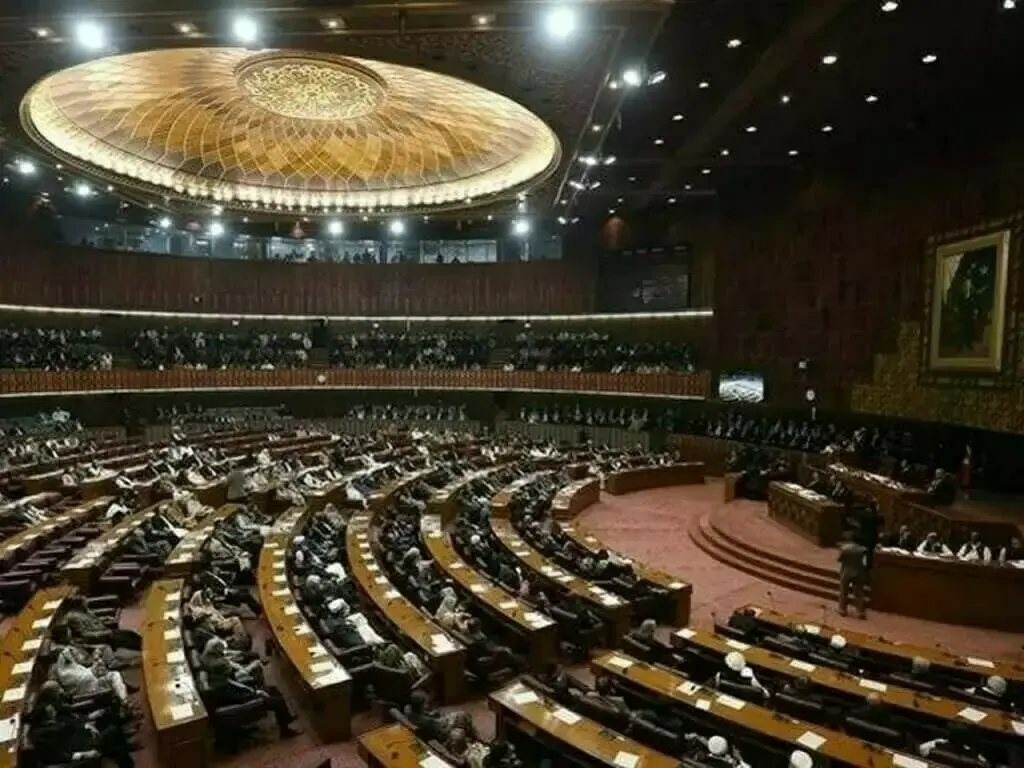
ISLAMABAD: The National Assembly on Wednesday passed key economic bills aimed at strengthening the country’s fiscal framework, promoting economic growth, and introducing reforms in the financial sector.
The bills approved by the lower house of parliament included the Fiscal Responsibility and Debt Limitation (Amendment) Bill, 2026; the Export-Import Bank of Pakistan (Amendment) Bill, 2026; the Special Economic Zones (Amendment) Bill, 2026; and the Netting of Financial Arrangements Bill, 2026.
State Minister for Finance Bilal Azhar Kiani tabled the four bills for passage, while Federal Minister for National Health Services Syed Mustafa Kamal presented ‘the Pakistan Nursing and Midwifery Council Bill, 2026’, and Federal Minister for Housing and Works Riaz Hussain Pirzada tabled ‘the Islamabad Capital Territory Condominium (Ownership and Management) Bill, 2026’ in the House for approval.
The House passed the bills with a majority vote.
READ MORE: Civil Servants Bill among 4 bills passed by NA
Two bills, the Pakistan Air Safety Investigation Amendment Bill 2026 and the Customs Amendment Bill 2026, were also introduced in the House.
According to the statement of object and reasons of ‘the Fiscal Responsibility and Debt Limitation (Amendment) Bill, 2026’ and “Fiscal Responsibility and Debt Limitation Act, 2005 (as amended up to 2022), provides for the reduction of federal fiscal deficit and ratio of public debt to Gross Domestic Product (GDP) to a prudent level through effective public debt management.
The Debt Management Office (DMO), inter alia, provides critical support to stakeholders. In order to elaborate its scope, enhance its empowerment, and provide a plausible framework for the DMO’s anticipated future expansion, an amendment is required.
The proposed amendment seeks to strengthen the DMO by providing necessary resources for the effective planning and execution of the Government’s debt management functions.
Clause 2 of the bill says, “The Director General and the Directors shall be appointed on a contract basis for a term of three years on the basis of eligibility criteria, including academic and professional qualifications and experience, as may be prescribed. The contract may be extended subject to performance evaluation.”
According to the statement of object and reasons of “The Export-Import Bank of Pakistan (Amendment) Bill, 2026”, the amendments in the Act are designed to enhance governance frameworks, ensure regulatory compliance, and improve operational efficiency, while maintaining consistency with the overarching legal and regulatory framework applicable to state-owned enterprises.
“The proposed amendments are intended to ensure that the operations and governance of EXIM Bank are conducted in strict adherence to the legal and regulatory parameters established under the SOE Act. This will serve to reinforce principles of transparency, accountability, and sound corporate governance, thereby aligning the Bank’s operations with the broader national policy objectives.
The EXIM Bank (Amendment) Bill is designed to achieve the aforementioned purposes.”
According to the statement of object and reasons of ‘The Netting of Financial Arrangements Bill, 2026,’ over the years, the development of domestic financial markets in Pakistan has led to the introduction of innovative financial products and increased bilateral exposures of banks and other financial market participants. The complexities introduced by such products and exposures require the adoption of laws to prevent and reduce risks in the financial system.
“In this regard, the financial services industry typically uses contractual rights of set-off and netting arrangements not only to reduce such risks, but also to efficiently utilize credit, thus ensuring optimal use of regulatory capital.
In Pakistan, such netting arrangements are established bilaterally between counterparties through privately negotiated agreements or standardized agreements used globally, like International Swaps and Derivatives Association (ISDA) Master Agreements.
However, enforceability of such netting rights, in case of a termination event, bankruptcy, or insolvency proceedings, is not always certain, and the absence of a clear law obstructs the development of domestic financial markets and restricts international financial counterparties from transacting with local counterparties.
Copyright Business Recorder, 2026