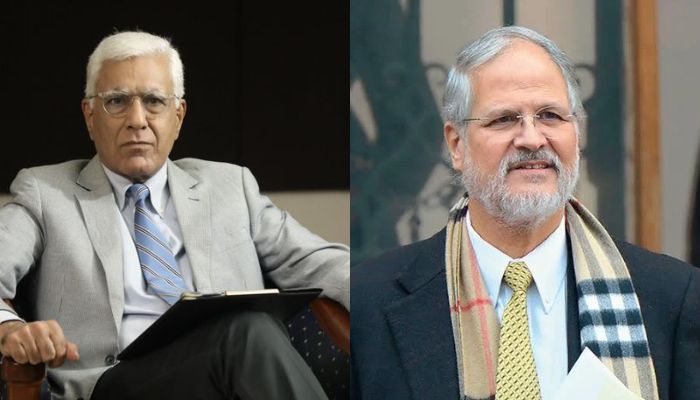
Former Delhi Lieutenant Governor and former Vice-Chancellor of Jamia Millia Islamia, Najeeb Jung, recently spoke to journalist Karan Thapar in an interview for The Wire and made a serious observation about the so-called condition of Muslims in India.
According to Jung, the Muslim community is in a “very grave” situation and is “knocking on the doors of becoming second-class citizens.”
His remarks once again brought back a debate that has been continuing almost continuously since Narendra Modi came to power in 2014. Every few years, some public figure whether a politician, actor, academic, or retired official raises concern that India is becoming unsafe or hostile for Muslims. The language changes, the examples change, but the core message remains the same: Muslims are supposedly losing their place in India.
But after more than twelve years of Modi-led politics at the Centre, an important question naturally comes up: has the prediction actually come true?
Najeeb Jung’s concerns about Muslim representation
In his interview, Najeeb Jung argued that Muslims today feel increasingly pushed away from the mainstream. He said many in the community believe they are being treated unfairly and excluded from the country’s progress. According to him, this feeling is not limited to ordinary citizens but is also visible in political and institutional spaces.
Jung pointed out that in states like West Bengal and Assam, where Muslims form a large part of the population, the BJP did not field Muslim candidates in recent elections. He also highlighted that for the first time since Independence, the Union government does not have a Muslim cabinet minister and the BJP has no elected Muslim MP in Parliament.
He further said that representation of Muslims in the higher bureaucracy, judiciary, and major institutions has reduced compared to previous decades. In his view, this shrinking visibility creates insecurity within the community. Jung warned that if a population of nearly 200 million people starts feeling politically unimportant, it could become dangerous for the country’s social balance.
His comments were direct. He stressed that only liberal sections of society appear openly worried about this issue, and he described that as “disastrous” for India.
However, critics of this argument say such fears have been repeated for years, often in dramatic language, but India’s Muslims continue to participate in elections, run businesses, study in universities, work in government jobs, and openly practice their religion across the country. They argue that political underrepresentation in one party does not automatically mean second-class citizenship.
The “Intolerance” debate started long ago
Najeeb Jung is not the first prominent figure to express fear about the direction India is taking under Modi’s leadership. In fact, this debate became national news within just a year of Modi becoming Prime Minister.
In 2015 and later in 2017, several well-known personalities made statements about “intolerance” and insecurity among Muslims in India.
One of the biggest names was former Vice President Hamid Ansari. Towards the end of his term in August 2017, Ansari said that many Muslims were experiencing “a feeling of unease” and insecurity in the country. He said he had discussed the issue of intolerance with Prime Minister Modi and senior ministers in the government.
Before Ansari’s remarks, Bollywood had already entered the debate
In November 2015, Shah Rukh Khan spoke about what he called “extreme intolerance” in India. During interviews around his 50th birthday celebrations, SRK said there was growing religious intolerance in society. His statement immediately became national news.
Soon after that, actor Aamir Khan made even stronger remarks during the Ramnath Goenka Excellence in Journalism Awards event in New Delhi.
Aamir revealed that his wife, filmmaker Kiran Rao, had at one point suggested leaving India because she was worried about the atmosphere in the country and feared for the safety of their children. He said she was scared after reading newspapers every day and felt concerned about rising tensions in society.
The statement created a political storm. The debate became so heated that it dominated television discussions and newspaper headlines for days.
What is important here is that these warnings are not new; they were made nearly a decade ago. Since then, similar claims have appeared again and again that Muslims are unsafe, democracy is collapsing, minorities are being pushed out, and India is becoming intolerant.
Yet India’s social and political reality has remained far removed from these dramatic predictions.
Twelve years later, have Muslims become “second-class citizens”?
This is where the debate becomes serious. If one listens only to political speeches and television debates, it may appear that Muslims in India have already lost all rights and freedoms. But everyday reality tells a different story.
Muslims continue to vote freely in elections. Muslim political parties and leaders still contest and win seats in different states. Muslims continue to run businesses, own property, study in top universities, and work in sectors ranging from films and sports to bureaucracy and law.
Shah Rukh Khan is still giving superhit movies. Aamir Khan continues to live in India, with his children, though he has divorced his wife.
In essence, India still has Muslim actors who dominate Bollywood, Muslim industrialists, Muslim judges, Muslim journalists, Muslim athletes, and Muslim civil servants. Mosques function openly across the country, Eid is celebrated nationally, and Islamic institutions continue to operate legally.
Muslims continue to live like Hindus, Buddhists, Jains, and Christians do. But when voices who are considered ‘influential’ keep making alarmist claims like ‘Muslims are soon going to be become second-class citizens”, it polarises the community and creates permanent fear inside the community members. Since it has been repeated so many times since 2014 that it has almost become a political slogan rather than a proven reality.
Many also argue that if the government truly intended to completely marginalise Muslims, it would not continue introducing welfare schemes that directly benefit Muslims.
Modi Government’s outreach towards Muslims
Interestingly, while critics accuse the Modi government of ignoring Muslims, the BJP has repeatedly taken several steps for the welfare of Muslim citizens, especially women and poorer sections.
One of the biggest examples was the law against instant triple talaq. The Modi government introduced legislation to ban the practice of instant triple talaq, also known as talaq-e-biddat. This practice allowed a Muslim husband to divorce his wife instantly by saying “talaq” three times.
The Muslim Women (Protection of Rights on Marriage) Act, 2019 came into effect on August 1, 2019. The law declared instant triple talaq illegal and void. It also made the practice a criminal offence, with punishment of up to three years in jail for the husband.
The law was necessary to protect Muslim women from arbitrary divorce and insecurity. Supporters described it as a major reform for gender justice inside the Muslim community. Conservative Muslim leaders opposed it, still the BJP presented the law that protected Muslim women.
Another example came in 2025 ahead of Eid, when the BJP launched the “Saugat-e-Modi” campaign.
Under this programme, around 32 lakh poor Muslims across the country reportedly received special kits containing food and daily-use items. The kits included vermicelli, dates, sugar, dry fruits, clothes, and other Eid-related essentials. Women received fabric for suits, while men received kurta-pyjamas.
The BJP promoted the campaign as an effort to connect directly with economically weaker Muslims and ensure festive support reached families before Eid celebrations.
Supporters of the government point to such initiatives and ask a simple question: if Muslims were truly being treated as second-class citizens, why would the ruling party spend political energy and resources on schemes specifically aimed at Muslim women and poor Muslim families?
Twelve years of warnings, yet India remains the same democracy
Since 2014, India has repeatedly heard fearmongering that Muslims are on the verge of losing their place in society. Leftwing intellectuals like to exagerrate threat perception for Muslims as it serves their purpose of continuing to slander the BJP as a communal force while ensuring Muslims as vote bank remain loyal to the left parties.
But after twelve years of PM Modi’s rule, Muslims in India still retain their constitutional rights, religious freedom, voting power, and public visibility.
It simply shows that dramatic predictions about Muslims becoming second-class citizens must be tested against ground reality. When the same warnings are repeated for over a decade, yet the predicted collapse never materialises, many Muslims naturally begin questioning whether fear has been deliberately cultivated as a political tool to secure their votes. This may also explain why several Left parties and self-proclaimed “custodians” of Muslim interests have been struggling electorally in recent years. Muslim voters appear to be increasingly unwilling to remain political pawns in fear-driven narratives.